A personality quiz designed for social sharing and one designed for lead generation can cover the same topic. Still, they are built differently, measured differently, and produce different outcomes for the creator. The person taking the quiz might not notice. The person who built it will.
The category of “personality quiz” is broader than it looks. Some formats are built for reach. Others capture leads. Others move someone from browsing to buying. Each has a distinct structure, and using one to do another’s job is where most quiz projects go wrong.
This article covers five personality quiz types, what each one achieves, and how to choose the right format before you write a single question.
Table of Contents
Not All Personality Quizzes Serve the Same Purpose
The word “quiz” covers a wider range of formats than most people realize when they first decide to build one. Some quizzes are optimized for reach, designed to spread across social feeds and introduce new audiences to your content. For instance, BuzzFeed-style personality quizzes.
Others are optimized for depth, gathering enough information about a user to place them into a meaningful segment before sending them into a follow-up sequence. Others are built purely to move someone from browsing to buying.
The format mismatch between quiz type and business goal is one of the more common reasons quizzes fail to produce results worth measuring. A quiz that looks engaging but delivers no actionable outcome for the creator is a format problem, not a content problem. Getting the type right before writing a single question saves considerable rework later, and is the first decision that determines whether you end up with a personality quiz that people actually complete and share.
5 Personality Quiz Types (and When to Use Them)
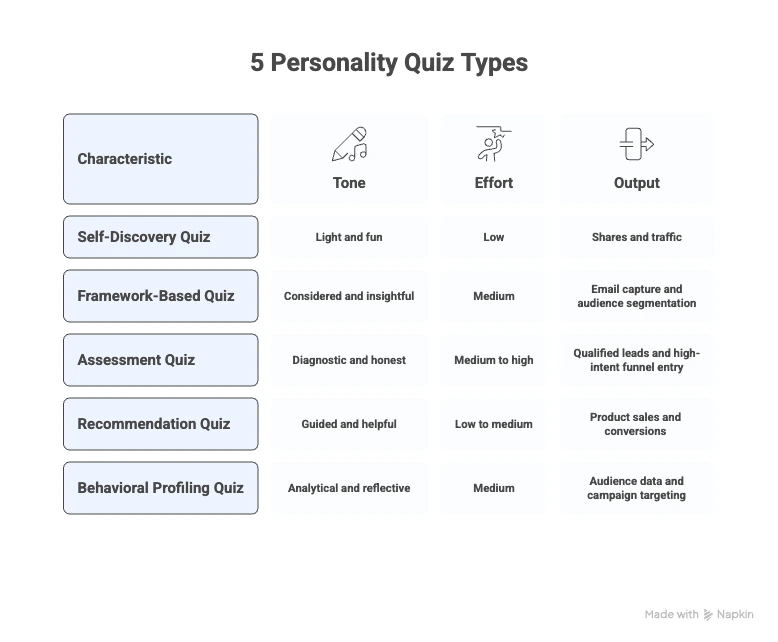
Choosing the right personality quiz starts with knowing what each type is actually built to do.
1. Self-Discovery Quizzes (For Engagement and Traffic)
Self-discovery quizzes ask about preferences, habits, or tastes and deliver a result that reflects something about who the user is. The tone is light, the questions require minimal effort, and the result is designed to be shared. A love language quiz, a mental age quiz, or a “What’s your aesthetic?” quiz all follow this structure.
The format works because the barrier to starting is low and the payoff arrives quickly. The result page doesn’t need to sell anything. It needs to be interesting enough that the user wants to show it to someone else.
Use this when your primary goal is reach, brand recall, or bringing new audiences to your content, and when you want to create a viral quiz that travels beyond your existing audience.
Best for: social sharing, top-of-funnel traffic, brand awareness.
2. Framework-Based Quizzes (For Lead Generation and Segmentation)
Framework-based quizzes use a structured model to place users into meaningful categories. The results carry more weight than a self-discovery quiz because they’re grounded in a recognizable framework, a personality model, a working style taxonomy, or a learning style system.
A leadership style quiz is a clear example. The result feels substantive, which is why users are willing to exchange their email address for it. For coaches, educators, and B2B creators, this format supports email capture and email segmentation in a single step.
Use this when you want to grow your list and segment your audience before sending them into a follow-up sequence.
Best for: email capture, audience segmentation, mid-funnel lead nurturing.
3. Assessment Quizzes (For High-Intent Leads)
Assessment quizzes evaluate where a user currently stands: their skill level, their readiness to invest, or their awareness of a problem. The result carries a degree of diagnosis rather than just description, which attracts users who are already close to a decision.
“Is your business ready to scale?” or “What’s your current fitness level?” are assessment formats. The result page is a natural place to introduce a high-ticket offer, a discovery call, or a detailed follow-up sequence.
Use this when your audience is problem-aware, and you want to qualify leads before they enter your sales process.
Best for: qualified leads, high-ticket funnels, service-based, and consulting businesses.
4. Recommendation Quizzes (For Sales and Conversions)
Recommendation quizzes match users to a specific product or service based on their answers. The result delivers a direct recommendation with a clear path to purchase, and the result page functions as a personalized sales page.
A skincare quiz, a product finder for a supplement brand, or a program matcher for a coaching business all follow this structure. Quizzes that recommend products are particularly effective where product variety creates decision paralysis..
Use this when your primary goal is conversion and your products or service tiers map cleanly to different user profiles.
Best for: product sales, guided buying experiences, ecommerce, and service conversions.
5. Behavioral Profiling Quizzes (For Audience Insights and Targeting)
Behavioral profiling quizzes ask about how users think, make decisions, and respond to different situations. The primary output is data for the creator rather than a compelling result for the user. A buying style quiz or a decision-making style quiz falls into this category.
The data informs ad copy, email tone, and offer framing more precisely than demographic data alone can, making this format useful for planning a campaign or refining a positioning strategy.
Use this when you need audience data to improve targeting, rather than for an immediate conversion.
Best for: audience research, campaign optimization, message refinement.
How to Choose the Right Personality Quiz for Your Goal
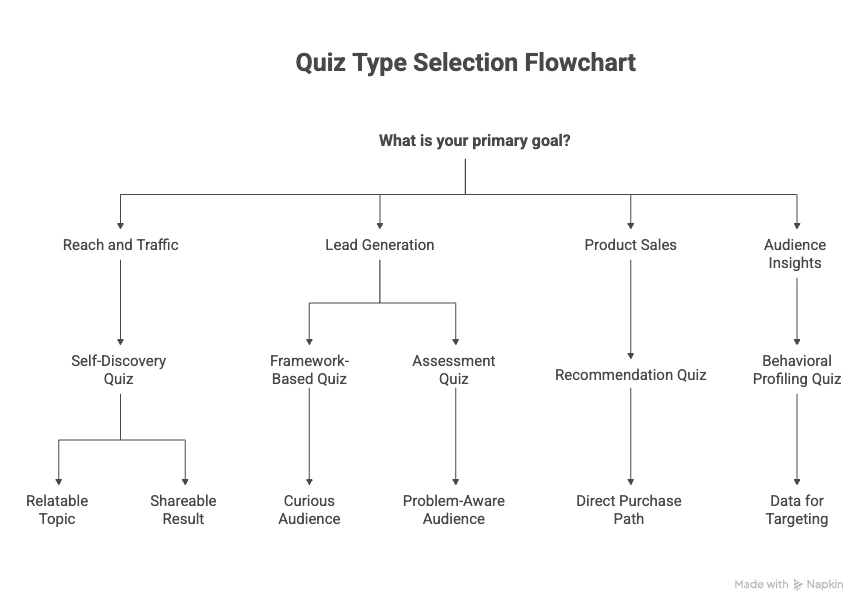
If Your Goal is Engagement and Traffic
Build a self-discovery quiz. Keep the topic tied to something your audience already thinks about and write a result people will want to show others. The primary measure of success is shares and new visitors, not email signups or sales.
If Your Goal is Lead Generation
Build a framework-based quiz or an assessment quiz, depending on where your audience sits in their journey.
- Framework-based: Works for audiences who are curious and want to understand themselves better in relation to your topic.
- Assessment: Works for audiences who are already problem-aware and evaluating their options.
Both formats support email capture and produce result-level data that makes follow-up sequences more relevant than a generic welcome email.
If Your Goal is Product Sales
Build a recommendation quiz. The user answers questions about their situation, the quiz maps those answers to the right product, and the result page presents a clear purchase path.
If Your Goal is Audience Insights
Build a behavioral profiling quiz. Keep questions focused on decision-making patterns and behavioral tendencies rather than surface preferences. The primary output is data that improves your marketing, not a result that drives an immediate action.
Choose Your Quiz Type and Start Building
Key Features You Need to Build These Quizzes
Each of the five quiz types has slightly different structural requirements, but several features matter across all of them.
Tools like Quiz and Survey Master (QSM) make it possible to build any of these formats on WordPress without custom development. The features that consistently matter are:
- Conditional logic: Questions adapt based on previous answers, producing more accurate results and a smoother experience across all quiz types.
- Result-based outcomes: Each quiz type requires distinct result pages. The ability to build and customize these separately is what makes results feel tailored.
- Customizable result pages: Full control over copy, layout, and call to action on each result page separates a quiz that converts from one that just collects responses.
- Email integrations: Connect quiz results to your email platform, tagged by result type, for segmented follow-up sequences from day one.
- Zapier and webhook support: Pass quiz data to your CRM, Google Sheets, or any other tool in your stack automatically after each completion.
Build Your Quiz with QSM
How This Fits Into a Quiz Funnel
Every quiz type covered in this article fits into a quiz funnel at a different stage, and where yours sits determines the follow-up system you build around it.
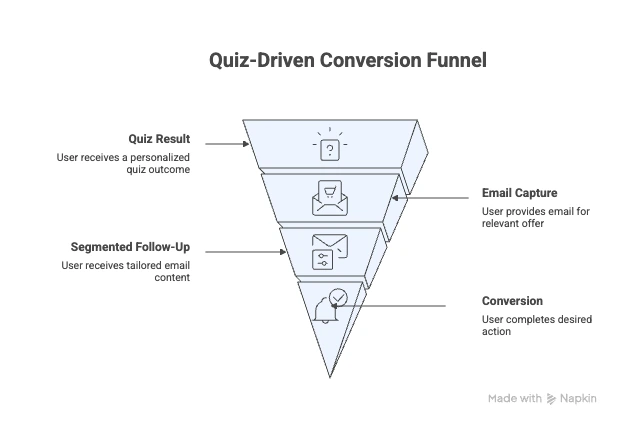
The flow is consistent across quiz types: the quiz delivers a result, the result page captures the user’s email in exchange for something relevant, and the follow-up sequence speaks directly to the segment or profile the user landed in.
- Self-discovery quiz: Result page introduces your brand. User enters a broad welcome sequence.
- Framework-based quiz: User gets placed into a segment. “The Visionary” gets big-picture strategy content. “The Executor” gets systems and implementation content.
- Assessment quiz: Result reflects where the user currently stands. Early-stage users get foundational content. High-scorers get introduced to a premium offer or discovery call.
- Recommendation quiz: User gets matched to a product with a direct purchase path. Follow-up handles post-purchase onboarding or abandoned cart recovery.
- Behavioral profiling quiz: User gets a useful result. Creator gets decision-making data that sharpens ad copy, email tone, and offer framing.
The entire quiz experience, from the first question to the result, can function as a quiz lead magnet. The result is what the user came for. When it lands well, the email capture follows naturally.
Start Building the Right Quiz for Your Goal
The quiz type you choose shapes every decision that follows: the questions, the results, the follow-up sequence, and the outcomes you can measure. Each format covered in this article has a specific job. Match it to your goal before you write a single question.
FAQs
What is a product recommendation quiz?
A product recommendation quiz maps a buyer’s answers to a specific product, so the result page does the selling instead of a generic product listing.
Where should I ask for an email in a personality quiz?
After the last question, before the result. Curiosity is at its peak at that point, which is why conversion rates are significantly higher there than at the start or mid-quiz.
Which type of personality quiz generates the most leads?
Framework-based and assessment quizzes outperform self-discovery quizzes for lead generation because the result feels substantive enough to exchange an email for. Self-discovery quizzes generate more shares but fewer signups.
How do I know which quiz type is right for my business?
Start with your goal. Engagement and traffic: self-discovery quiz. Lead generation: framework-based or assessment quiz. Product sales: recommendation quiz. Audience research: behavioral profiling quiz. The format follows the goal, not the other way around.