You clicked on a BuzzFeed quiz, telling yourself it would take two minutes. Twenty minutes later, you were four quizzes deep, and you’d already sent one result to a friend.
“Which Friends character are you?” “What does your coffee order say about you?” “Which Hogwarts house do you belong to?” These quizzes pull people in within seconds, and people don’t just take them. They share them.
It feels personal, it’s fast to complete, and the result lands in a way that makes people want to show it to someone else. In this article, we’ll break down why these quizzes work so well and how you can use the same approach for your own audience.
Table of Contents
What Are BuzzFeed-Style Personality Quizzes?
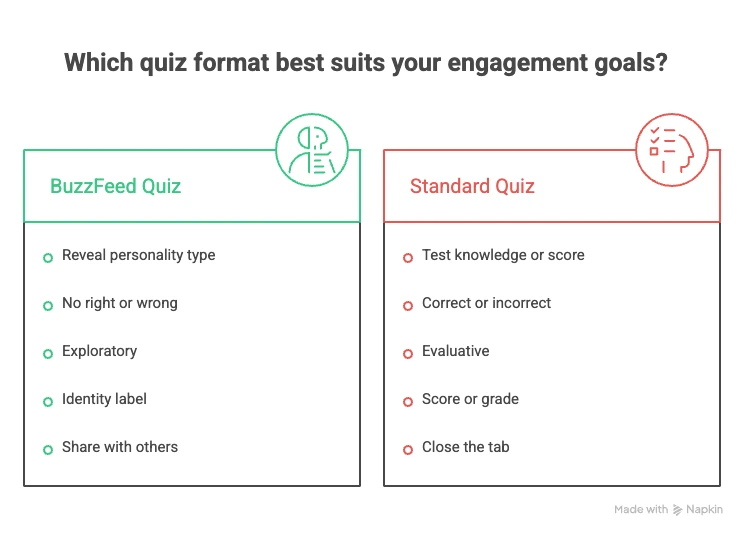
BuzzFeed-style personality quizzes are outcome-based quizzes where the result is a personality type, character match, or identity label rather than a score or a grade. The format is built around one central question: which type are you?
You answer a short set of questions about your preferences, habits, or instincts, and the quiz maps those answers to a predefined result. That result is the entire point of the experience. It tells you something about yourself, frames it in an interesting or flattering way, and gives you something concrete to walk away with.
The experience is exploratory rather than evaluative. That removes pressure and replaces it with curiosity, which is a more comfortable state to be in.
Why BuzzFeed Personality Quizzes Are So Addictive
Each element of a BuzzFeed-style quiz is designed around how people respond to identity-based content. The questions, the result, and the sharing behavior are all connected by the same underlying dynamic.
They Feel Personal Instantly
The results in a well-made BuzzFeed-style quiz feel tailored, even when they’re not. Because the questions are grounded in personal preferences and everyday scenarios, your answers feel like a genuine reflection of who you are. When the result arrives, it carries the weight of that process. The label feels earned rather than assigned.
They Tap Into Identity Curiosity
People are consistently drawn to content that helps them understand themselves better or that confirms something they already suspected about themselves. A quiz that tells you “you’re the strategic one in every group”, “you lead with empathy before logic”, or “you’re the one who over-explains everything but is usually right”, gives you a label you can hold onto. gives you a label you can hold onto. Labels are satisfying because they organize something abstract, personality, into something nameable.
They Are Built for Sharing
The “this is so me” effect is what drives sharing behavior. A screenshot posted to Instagram Stories takes two seconds and says something personal without requiring the person to write anything. Sharing a quiz result is a low-effort way of communicating something personal, which is exactly why it travels so well on social media.
They Are Easy and Fun to Complete
The format is deliberately low-friction. Questions are short, answers are presented as clear options, and the whole experience typically takes two to three minutes. There’s no preparation required and no wrong answer to worry about. That ease is intentional. The faster and more effortless the experience, the higher the completion rate.
What Makes These Quizzes Go Viral
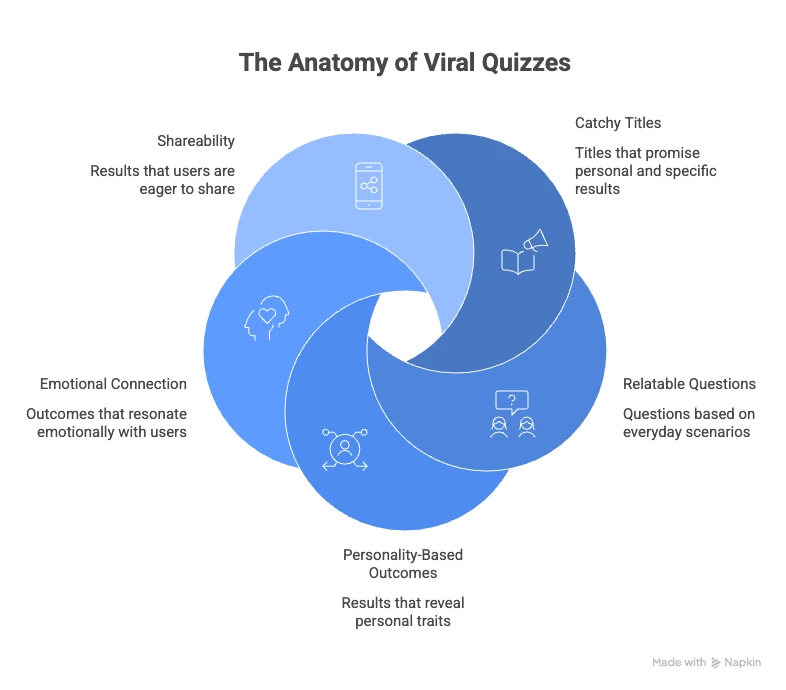
A Result Worth Showing Someone Else
When a result feels accurate, users share it without being prompted. They’re not sharing your content. They’re sharing something that says something about them. That’s the distribution mechanism most content formats never get.
A Title That Promises Something Personal
The title carries the first impression. “Which type of traveler are you?” or “What does your morning routine say about you?” signals immediately that the result will be personal. That promise is what earns the click for a viral quiz.
Questions That Feel Like a Conversation
Everyday scenarios are easier to answer than abstract ones. “Do you plan every detail of a trip or figure it out as you go?” requires no self-analysis. “How would you describe your decision-making style?” does. Lower cognitive load means higher completion rates.
An Outcome That Lands Emotionally
A result that makes someone feel seen travels further than one that’s just correct. Accuracy gets a nod. Emotional resonance gets a screenshot and a share.
A Result That Says Something About Who You Are
A score tells you how you performed. A personality-based outcome tells you who you are. That’s why people share quiz results and not test scores.
Real Examples of BuzzFeed-Style Quizzes That Work
The format travels across a wide range of topics, which is part of what makes it useful for creators in different niches.
- Personality type quizzes: Almost everyone has an opinion about where they fall on the introvert/extrovert spectrum, and is curious whether a quiz agrees.
- Lifestyle quizzes: Topics like cooking, travel, or daily habits connect to things people already think about. The quiz just gives them a label for it.
- Fandom quizzes: “Which character are you?” taps into identity within a community, something people feel strongly about and enjoy displaying.
- Relationship quizzes: Love language quizzes perform well because the result is easy to share with a partner or close friend, which doubles the distribution.
- Fashion style quizzes: Taste is something people are happy to have reflected back at them, and results are visual enough to share easily.
- Leadership style quizzes: The format translates naturally into B2B and career contexts, where the result speaks directly to how someone sees themselves at work.
Each of these works because the topic connects to something you already care about, and the result gives you a way to articulate it.
Why Creators and Marketers Use BuzzFeed-Style Quizzes
For creators, a BuzzFeed-style quiz generates engagement that most content formats can’t match. Interactive content like quizzes sees completion rates significantly higher than comparable static content.
A well-titled quiz brings in traffic from search and social, keeps people on the page through the completion experience, and then sends them back out into social feeds when they share the result. That cycle of arrival, engagement, and redistribution is difficult to replicate with a standard blog post or video.
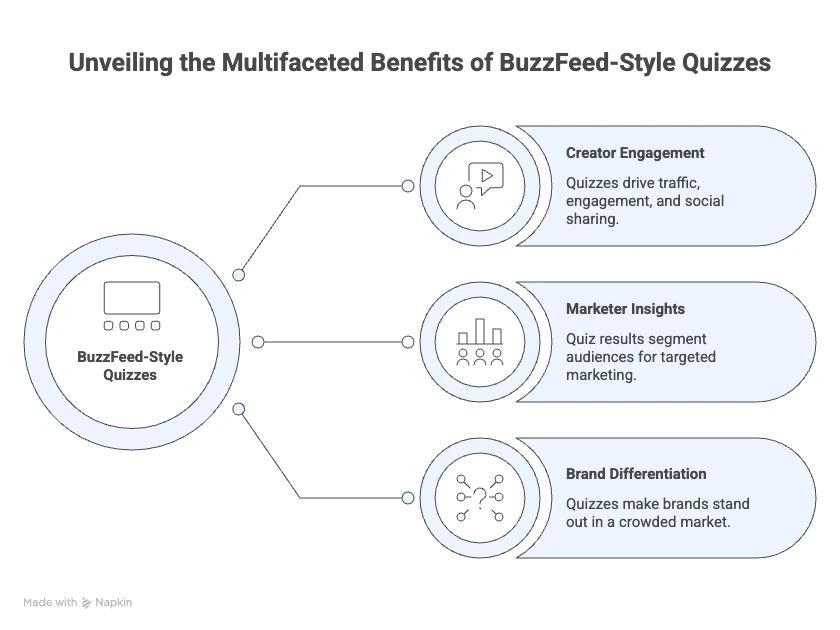
For marketers, the value goes further. A quiz result tells you something about the person who took it. If your quiz produces three or four distinct outcome categories, you have a rough segmentation of your audience based on how they self-identify. That information shapes everything from content planning to product recommendations to email sequences, helping you generate leads with quiz marketing.
The format also differentiates. In a content landscape where most creators are publishing the same types of articles, guides, and videos, a personality quiz stands out as something interactive and personal. It gives your audience a reason to spend more time with your brand and a reason to come back.
How These Quizzes Fit Into a Bigger Content Strategy
A BuzzFeed-style quiz earns attention quickly. What happens after that attention is captured is where most creators leave value on the table.
The quiz result is a natural handoff point. Once you receive your result, you’re in a receptive state. You’ve just engaged with the content, you feel a degree of connection to what you’ve learned about yourself, and you’re open to what comes next. That’s the moment to offer something that goes deeper.
Connecting the quiz to a lead magnet is the most direct application. If someone finds out they’re a particular type, offer them a resource tailored to that type. If someone gets “The Intuitive Eater” in your food personality quiz, the lead magnet waiting for them is their intuitive eating guide, not a generic newsletter signup.
A guide, a checklist, or a short email sequence that speaks directly to their result converts far better than a generic opt-in because the relevance is built in.
From there, the quiz can function as the entry point to a full quiz funnel, where each result routes people toward different content, offers, or follow-up sequences. The quiz identifies where someone is. The funnel takes them somewhere useful from there.
What starts as a fun, shareable piece of content can become a structured engagement strategy. The format supports both goals.
What This Looks Like in Practice
For instance, a fitness creator builds a quiz called “What’s Your Training Personality?” with four result types: The Competitor, The Consistency Builder, The Stress Reliever, and The Social Trainer.
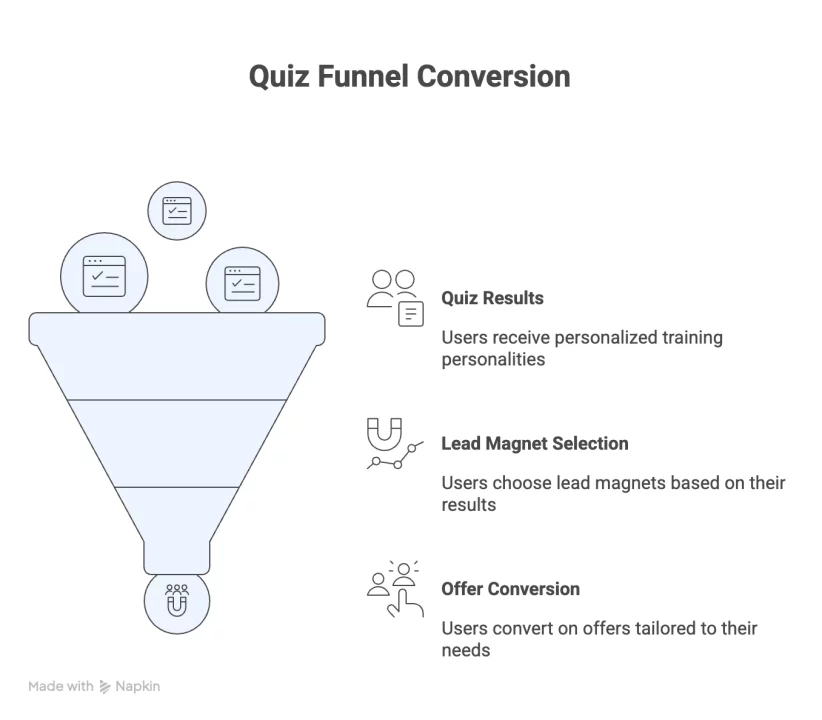
Each result routes to a different lead magnet. The Competitor gets a progressive overload training plan. The Consistency Builder gets a 30-day habit tracker. The Stress Reliever gets a recovery-focused workout guide. The Social Trainer gets a partner workout program.
Each lead magnet ends with a relevant offer. The Competitor sees a performance coaching program. The Consistency Builder sees a habit coaching membership. The quiz does the segmentation, the lead magnet builds the relationship, and the offer closes it.
One quiz generates four distinct funnels, each speaking directly to a different type of person in your audience.
Creating BuzzFeed-Style Personality Quizzes for Your Audience
To create a BuzzFeed-style quiz that actually performs, you need more control than most basic tools offer: how answers map to results, how results are displayed, and how the flow feels from start to finish.
Quiz and Survey Master (QSM) is built for exactly this. Design the full experience on WordPress, customize how results are assigned, and build quiz flows that match your content strategy. Whether you want to create a BuzzFeed quiz for a broad audience or something niche like a fashion style or leadership quiz, QSM gives you the control to execute it properly.
Want to create your own BuzzFeed-style personality quiz? Start building one with QSM.
FAQs
How do I create a BuzzFeed quiz?
Write each outcome description first, then build questions that map to them. This keeps the results coherent and prevents questions from feeling disconnected from the payoff. Each question should push toward one result without telegraphing which answer leads there.
What’s the ideal number of questions for a BuzzFeed-style quiz?
Between 5 and 10. Fewer than 5, and the result feels arbitrary. More than 10 people drop off before they see it.
Do personality quizzes work for lead generation or just engagement?
Both, but lead generation only works if the result connects to a specific offer. A generic newsletter signup at the end wastes the segmentation the quiz just did. Tie each result to a targeted lead magnet, and conversion follows.
How do I choose a quiz topic that my audience will actually click on?
Pick something your audience already has an opinion about. If they’re already debating it, a quiz meets existing curiosity rather than trying to create it. The title should complete a question they’ve already been asking themselves.
How do I make my own BuzzFeed quiz?
Start with your result types, write the outcome descriptions first, then build questions that map to each one. QSM lets you do this directly on WordPress, with full control over how results are assigned and displayed.