Creating a personality quiz is easy. Knowing how to make a personality test that people actually finish and share is considerably harder.
Most quizzes fail before they get a chance to do anything useful. They feel generic, the questions are dull, and the results tell people something they already know in language that could apply to anyone. Participants drop off halfway through or reach the end feeling vaguely cheated. That’s not a quiz problem. That’s a design problem.
In this guide, we’ll break down what actually makes a personality quiz work, from structure to results to engagement.
Table of Contents
What Makes a Personality Quiz Worth Taking?
Before you make a personality quiz, three things determine whether someone finishes a personality quiz: it has to feel personal, it has to feel relevant to something they care about, and it has to promise a result that’s worth the effort of getting there.
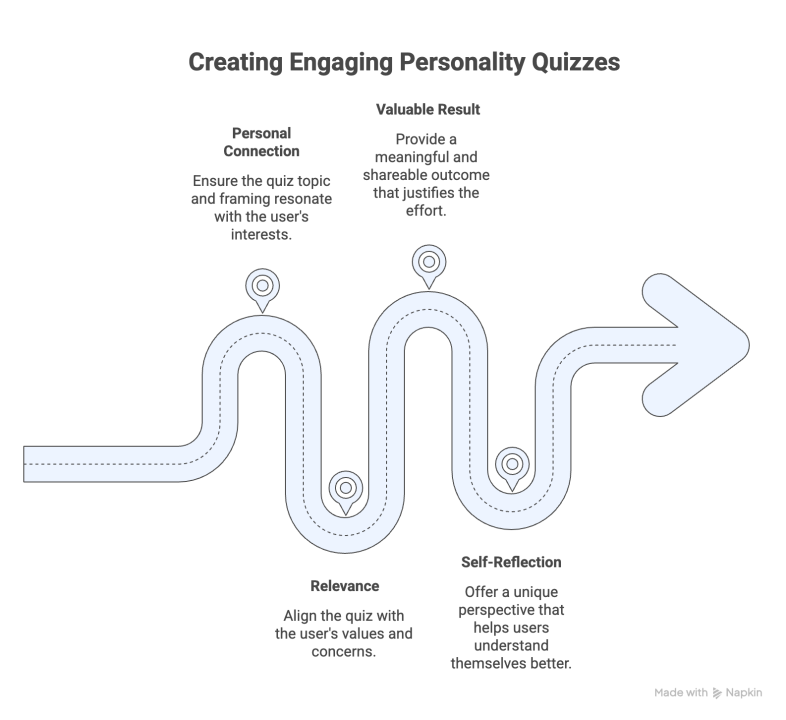
The first two are about the topic and framing. The third is about how well the quiz pays off at the end. Most quiz creators focus heavily on the questions and forget that the result is the actual product. That’s where the experience either lands or falls flat.
There’s a deeper reason personality quizzes work when they’re done well. People don’t take them purely for information. They take them because they want to see themselves reflected interestingly. The quiz is a mirror, and the result is what they’ll carry with them (and screenshot, and share). Every design decision you make should serve that goal.
Start With the Right Quiz Idea
A good quiz topic doesn’t have to be complex. It has to connect to how someone sees themselves or how they want to be seen.
Topics that work are rooted in the reader’s own life. “What type of creator are you?” works because most content creators are curious whether a quiz matches their own sense of their style. “What’s your working style?” and “Which aesthetic fits you?” work for the same reason: they’re tied to taste and identity, which are personal by definition.
Topics that fail are usually too broad. “What kind of person are you?” tells the reader nothing specific about what they’ll get. The more precisely you name the territory your quiz covers, the more likely the right people are to start it. This is where you choose the right personality quiz for your goal: engagement, lead generation, or sales.
Structure Your Quiz for Completion
The length of a quiz is one of the most commonly misjudged variables. Most quizzes are too long, and drop-off happens gradually with every question past the first five or six.
The sweet spot is 5 to 10 questions: enough to produce a credible result, short enough that most people finish. Anything beyond 10 needs a compelling reason to exist, and that reason is rarely strong enough to justify the completion rate you’ll lose.
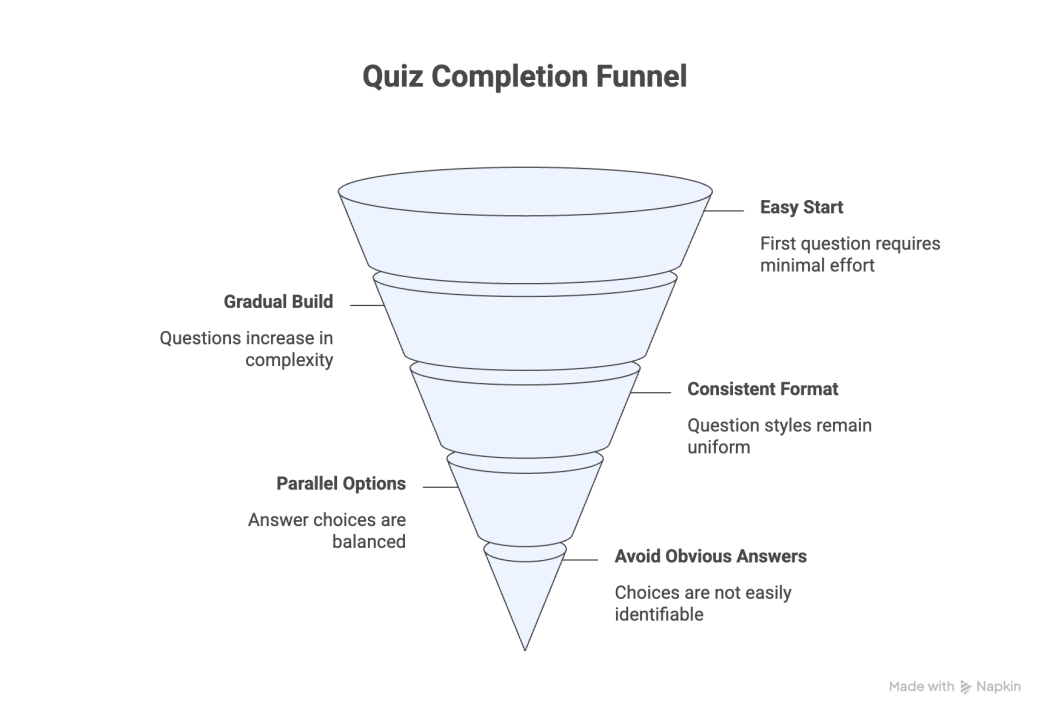
Structure matters beyond just length. A few principles that hold up in practice:
- Start easy. The first question should require almost no thought. It gets the participant moving and commits them to continuing.
- Build gradually. Questions that require more reflection are better placed in the middle, after the reader is already engaged.
- Stay consistent in format. Mixing very different question styles mid-quiz creates friction. If you’re using scenario-based questions, stick with that format throughout.
- Keep answer options parallel. Each answer should feel like it belongs in the same set as the others. Mismatched options slow people down and create confusion about what the quiz is actually measuring.
- Avoid answer options that are obviously “correct.” If one choice is clearly the admirable or aspirational one, everyone picks it, and the result loses all meaning.
The goal is completion, not comprehensiveness. A shorter, tighter quiz that everyone finishes is worth far more than a thorough one that half the audience abandons on question seven.
Write Questions That Feel Personal, Not Generic
The difference between a question people engage with and one they click through without thinking comes down to specificity and tone.
Generic questions produce disengaged answers. “What do you prefer: being around people or being alone?” is technically valid but feels like a survey. “How do you usually feel halfway through a social event you were looking forward to?” covers the same territory while placing the reader in a real moment. That difference changes how someone answers it.
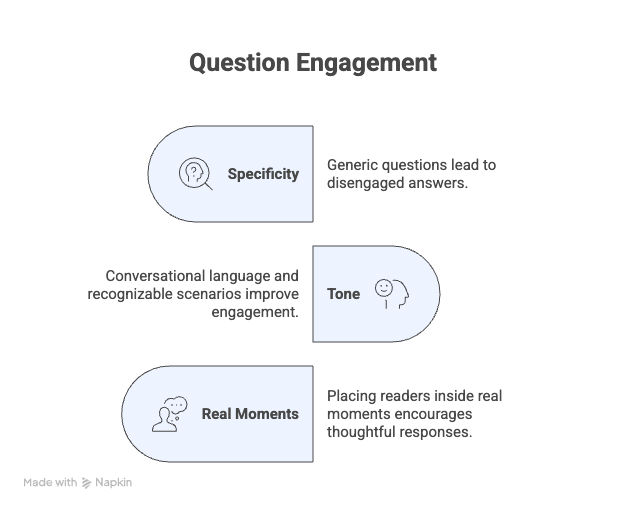
The best questions use conversational language and ground each scenario in something recognizable.
Before: “How do you make decisions?”
After: “Your friend asks you to weigh in on a big choice. What’s your first instinct?”
The second version gives the reader something to picture.
A few things to avoid:
- Jargon or questions that assume prior knowledge
- Framing that makes one answer sound obviously better than the others
- Any option that a reader would never genuinely choose
Map Answers to Meaningful Results
The result is the moment the quiz has been building toward. A weak result kills the experience regardless of how good the questions were. When the result lands well, people share it. When it doesn’t, they leave the quiz without taking any action.
Mapping answers to results means deciding, before you write a single question, what categories your quiz will produce and what each one represents. Each answer option should connect clearly to one of those outcomes. This forces you to think through whether your results are actually distinct from each other.
Vague results are the most common failure point. Consider the difference:
“You’re a creative thinker who values connection.” Could describe anyone. Feels like a horoscope.
“You process by talking it through, thrive on collaborative energy, and probably have seventeen browser tabs open right now.” Same category, written in a way that makes someone feel seen.
Results should feel accurate and slightly surprising. The accuracy creates trust. The surprise, the thing the reader hadn’t quite articulated about themselves before, is what produces the screenshot and the share.
Make the Results Share-Worthy
People share personality quiz results when the result says something about them that they want others to see. That starts with the label, which functions as a kind of badge. Compare:
“Introverted Planner” – Accurate, but forgettable.
“The Quiet Architect” – Same idea, worth screenshotting.
A specific, interesting label is what separates a viral quiz from one that gets completed and forgotten. The description underneath matters just as much. It should be warm, recognizable, and written in second person:
“You tend to work in bursts of intense focus followed by deliberate rest. You’re not slow; you’re strategic, even when it doesn’t look like it from the outside.”
That kind of copy rewards the reader and gives them something worth sharing.
Common Mistakes That Kill Personality Quiz Engagement
Most personality quiz failures come from a small number of predictable errors.
- Too many questions. Every question past the natural stopping point costs you completion rate. If you’re at 12 questions, you likely have 4 that can be cut.
- Boring answer options. If all four answers to a question feel interchangeable, the question isn’t doing useful work. Each option should feel meaningfully different.
- Weak or vague results. A result that could apply to half your audience isn’t a result. It’s a placeholder. Specificity is what makes results feel real.
- No emotional connection. Personality quizzes work because they’re about the reader. Questions that feel administrative or detached break that connection. Every question should feel like it belongs in a conversation, not a form.
- Results that feel like verdicts. The tone of a result matters. A result that sounds clinical or slightly critical will not get shared. Results should feel like a generous, accurate observation from someone who pays attention.
- Mismatched topic and audience. A quiz titled “What kind of entrepreneur are you?” that attracts a general audience will produce confused results. The topic, the platform it lives on, and the people you’re trying to reach need to be aligned before any other decisions matter.
Turning a Personality Quiz Into a Growth Asset
A personality quiz designed as part of a content strategy does considerably more work than one that just sits on a page and collects traffic.
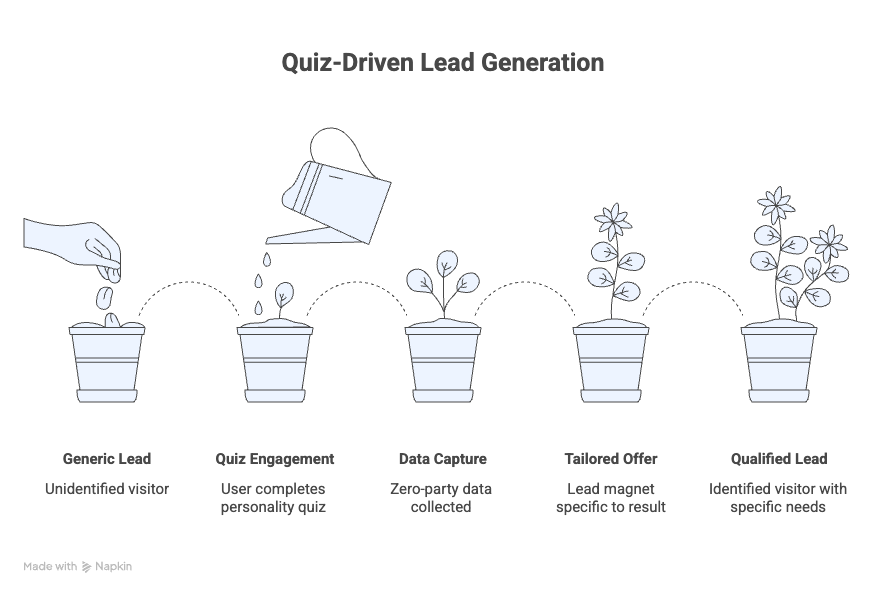
Quizzes are one of the few content formats that collect zero-party data: information people give you directly and willingly. Each result tells you something about how that person sees themselves, what they’re looking for, and where they are relative to the problem your product or service addresses. That data has real value when you build a system around it.
The most direct next step is connecting the quiz to a lead magnet. After someone receives their result, offer them something that goes deeper into the category they landed in:
- A guide or checklist tailored to their result type
- A resource that speaks to the specific problem their results surface
- A follow-up sequence that routes them toward relevant content or products
The relevance of that offer is much higher than that of a generic lead-capture form, and the conversion rate reflects it. You can find more on building this kind of offer in our guide to quiz lead magnets.
From there, a quiz can serve as the entry point to a full quiz funnel, where each result routes the reader toward different content, products, or follow-up sequences. The quiz becomes the diagnostic layer at the top, and everything that follows is shaped by what the reader revealed about themselves.
A well-designed personality quiz is the starting point for a broader engagement and lead strategy, not just a standalone piece of content.
Creating a Personality Quiz With the Right Tool
Building a personality quiz well requires a platform that gives you control over the full experience, from how questions are structured to how results are assigned and displayed.
Without that flexibility, the strategy you’ve built falls apart during execution.
Quiz and Survey Master (QSM) is designed for exactly this kind of quiz. It gives you the tools to build, customize, and publish personality quizzes on WordPress without requiring custom development. The strategic foundation comes first, but the right tool makes it possible to execute without compromise.
Ready to create your own personality quiz? Start building one with QSM and turn engagement into real results.