Marketing teams are working with fewer reliable signals than before. Privacy rules, browser changes, and user awareness have reduced how much can be tracked in the background. As a result, many common ways of understanding intent and interest no longer work as well as they used to.
At the same time, marketers still need clarity. They need to know what users want, where they are in the decision process, and how to communicate with relevance. Zero-party data addresses this gap by relying on information users choose to share directly. This article explains what zero-party data is, why it matters today, and the practical ways marketers can collect it.
Table of Contents
What Zero-Party Data Actually Is
Zero-party data is information that users share directly with a brand, on purpose. It is given through clear actions such as answering questions, selecting preferences, or giving feedback. The user knows what they are sharing and understands how it will be used.
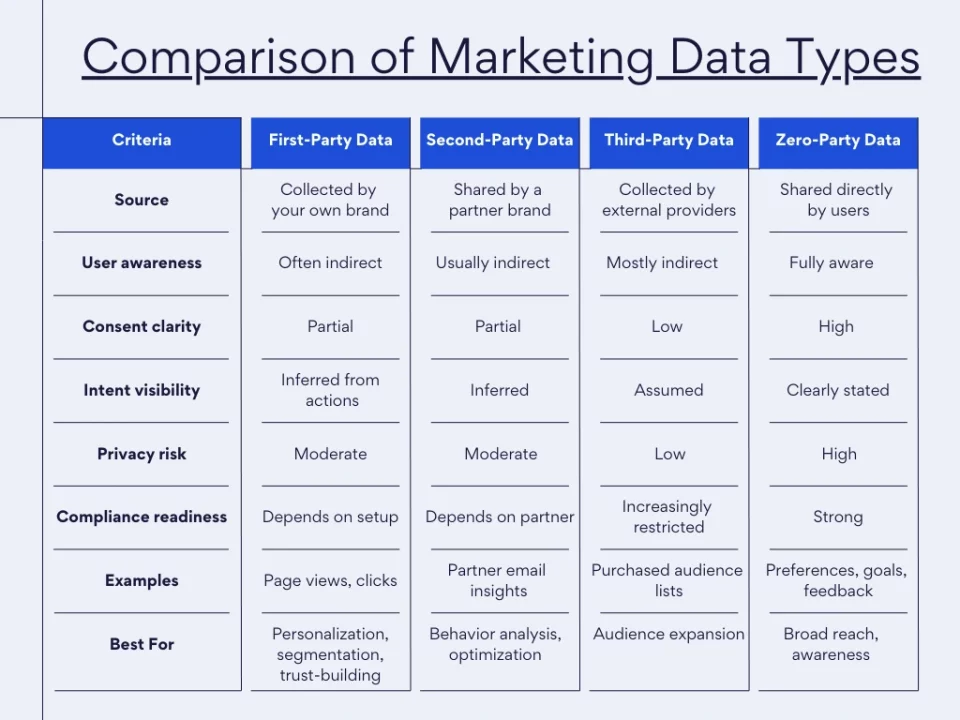
First-party data is collected by observing behavior on your own platforms. This includes page visits, clicks, or time spent on a page. While useful, it still requires interpretation. You see what users did, but not always why they did it. Second-party data is first-party data that another company shares with you through a partnership. It is usually limited in scope and depends on access agreements. Third-party data is collected from outside sources that track users across multiple sites and platforms. This data is often indirect, less accurate, and increasingly restricted due to privacy rules.
Zero-party data stands apart because it is permission-based and voluntary. Users actively provide it instead of being tracked in the background. Since the information comes straight from the source, it is generally more reliable and easier to use with confidence in both marketing and compliance workflows.
Why Zero-Party Data Matters for Modern Marketing
Zero-party data matters because it gives marketers clearer input at a time when many traditional signals are weakening. Privacy rules and browser changes have reduced what can be tracked passively, while user expectations around transparency have increased. Instead of relying on assumptions, zero-party data allows teams to work with information users have chosen to share.
Here is why it has become especially important for modern marketing:
- It works in a cookieless environment since data is shared directly, not collected through tracking.
- It aligns better with privacy rules and consent requirements across regions.
- It reduces dependence on third-party data sources that are often incomplete or outdated.
- It provides clearer intent signals instead of inferred behavior.
- It supports more relevant personalization across email, ads, and on-site content.
- It helps improve lead quality, not just lead volume.
- It shortens conversion paths by matching messages to stated needs.
- It builds trust by making data exchange transparent to users.
How to Collect Zero-Party Data (Top Strategies)
Zero-party data is collected when users clearly understand what they are being asked and why. The format should feel natural, the effort should be low, and the value exchange should be obvious. Below are the most effective ways marketers collect zero-party data across different stages of the funnel.
Preference Centers
Preference centers allow users to set their own choices instead of being grouped by assumptions.
They are commonly used in:
- Email subscription settings
- Account dashboards
- Onboarding flows
Users can select topics they care about, how often they want to hear from you, or which products interest them. This data stays accurate over time because users can update it whenever their needs change. It also reduces unsubscribes by giving users control instead of forcing an all-or-nothing choice.
Interactive Surveys
Surveys are one of the clearest ways to collect zero-party data, especially when they are short and focused.
They work well when placed:
- On key site pages
- After sign-up
- After a purchase or trial
- After a webinar or download
Surveys help capture opinions, priorities, and intent in the user’s own words or selections. The key is to avoid asking too much at once. A few relevant questions perform far better than long forms.
To improve accuracy and completion rates, create a survey with conditional logic. Instead of showing every question to every user, the survey adapts based on previous answers. This keeps the experience focused and prevents unnecessary friction. For example, if a user selects a specific product category, follow-up questions can explore their goals within that category rather than displaying unrelated options.
Product Feedback Forms
Feedback forms collect zero-party data after users have interacted with your product or service.
They are usually triggered:
- After a purchase
- After a free trial
- After a support interaction
This data helps marketers understand satisfaction levels, usage patterns, and future intent. It is especially useful for segmenting users based on experience, such as satisfied users, hesitant users, or those at risk of dropping off.
Content Engagement Tools
Some zero-party data is collected while users engage with content, without breaking their flow.
Common formats include:
- Polls inside blog posts
- One-click questions in newsletters
- Short interactive assessments
These tools work because they feel like part of the content rather than a separate request. Even simple inputs, such as interest level or topic choice, add useful context for future messaging.
Quizzes
Quizzes are a strong zero-party data format because asking questions is the core of the experience.
They work well because:
- Users expect to answer multiple questions
- Sharing preferences feels natural
- Engagement stays high through completion
Quizzes collect direct inputs such as needs, goals, and priorities, along with response patterns that add extra context. When done well, they provide both stated and behavioral insight without feeling intrusive. When structured strategically, quizzes also function as quiz lead magnets. Instead of offering a generic free resource, the quiz itself becomes the value exchange.
When to Ask for Zero-Party Data
Zero-party data performs best when questions are asked at moments of natural engagement. Instead of interrupting users at random, marketers should look for points where attention, intent, or investment is already present. Strategic timing improves both response quality and completion rates.
- During onboarding: New users are focused on understanding the product or service. This is a good time to ask about goals, use cases, or expectations without adding friction.
- On exit intent: When a user is about to leave, a short question can capture what held them back or what they were trying to find. This insight helps improve future messaging and page structure.
- After content is consumed: Users who finish a guide, article, or video are already engaged. Asking what they want next or which topic matters most often feels relevant at this stage.
- Mid-quiz: Users expect to answer questions in a quiz format. Adding follow-up prompts within the flow keeps responses natural and reduces drop-off. Because users are already engaged, this is often a good time to collect email address details in exchange for personalized results or a saved report.
- Post-purchase: After a purchase, users are more open to sharing preferences and feedback. This data supports retention, follow-ups, and better future recommendations.
What to Do with Zero-Party Data Once You Have It
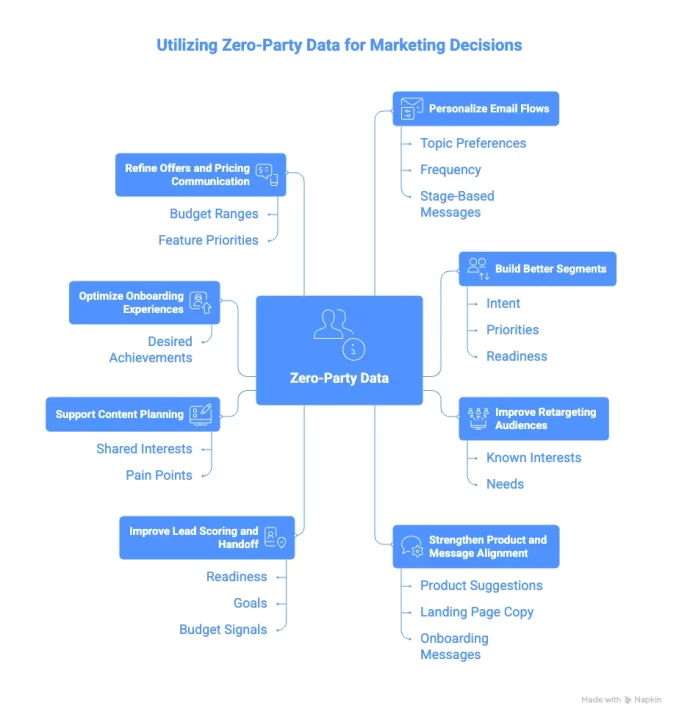
Many brands collect user feedback but fail to apply it consistently. Zero-party data becomes valuable only when feedback loops are closed. If users share preferences, concerns, or suggestions, those insights should directly influence messaging, product updates, and customer communication.
Personalize email flows
Use the preferences and goals users share to shape email content. This can affect what topics they receive, how often emails are sent, and what stage-based messages they see. When emails match what users care about, they feel more useful and are less likely to be ignored. When done consistently, this approach helps grow your email list with engaged subscribers who are more likely to convert.
Build better segments
Zero-party data allows teams to group users by intent, priorities, or readiness instead of surface-level actions. These segments stay meaningful because they are based on what users say they want, not just what they clicked once.
Improve retargeting audiences
Retargeting works better when ads reflect known interests or needs. Zero-party data helps avoid repeating the same message to everyone and instead shows offers that align with what users have already shared.
Strengthen product and message alignment
User input can guide product suggestions, landing page copy, and onboarding messages. This keeps marketing, product, and growth teams aligned around real user input rather than internal assumptions.
Improve lead scoring and handoff
Zero-party data adds context to leads before they reach sales. Teams can prioritize follow-ups based on readiness, goals, or budget signals.
Support content planning
Use shared interests and pain points to decide what content to create next. This ensures blogs, emails, and guides address real questions users care about.
Optimize onboarding experiences
Tailor onboarding steps based on what users say they want to achieve. This helps users reach value faster.
Refine offers and pricing communication
Understand budget ranges or feature priorities to present offers that feel relevant instead of generic.
Guide retention and upsell efforts
Use stated preferences to recommend next steps, upgrades, or related products at the right time.
Zero-Party Data Best Practices
Use this checklist to make sure your zero-party data collection stays useful, respectful, and effective.
- Ask only for information you will actively use
- Be clear about why each question is being asked
- Make the value exchange obvious to the user
- Collect data only with clear consent
- Keep questions short and easy to answer
- Avoid asking too much at one time
- Match questions to the right stage in the journey
- Let users update their choices anytime
- Store and use data responsibly
- Show how user input improves their experience
- Avoid hidden or misleading data collection
- Review and clean the collected data regularly
Key Takeaways on Zero-Party Data for Marketers
Zero-party data works best when it is treated as an ongoing input, not a one-time collection step. The goal is to ask clearer questions at moments where users are already engaged, and use those answers consistently across marketing decisions.
If you are starting out, focus on one channel and one use case first. Once that is in place, you can expand how and where zero-party data is used. In the next article, we look at quizzes as a practical way to collect zero-party data and understand user intent without adding friction.
Next, see how marketers use quizzes to collect zero-party data and understand user intent more clearly. Explore how quizzes can collect zero-party data.