Quiz builders spend most of their time on questions: which formats to use, how many options to include, and whether the flow feels natural. Questions are the foundation, but they don’t determine whether the quiz converts. The result page does. That’s where a user decides whether to sign up, buy, or leave, and a weak result page wastes every second of attention the quiz earned.
In this guide, we’ll break down how to create quiz results that actually drive action.
Why Quiz Results Matter More Than You Think
By the time a user reaches the result page, they’ve answered every question and are waiting for the payoff. Curiosity is at its peak, and that’s the decision moment: where they click, sign up, or buy. Everything the quiz earned in attention and curiosity gets spent here.
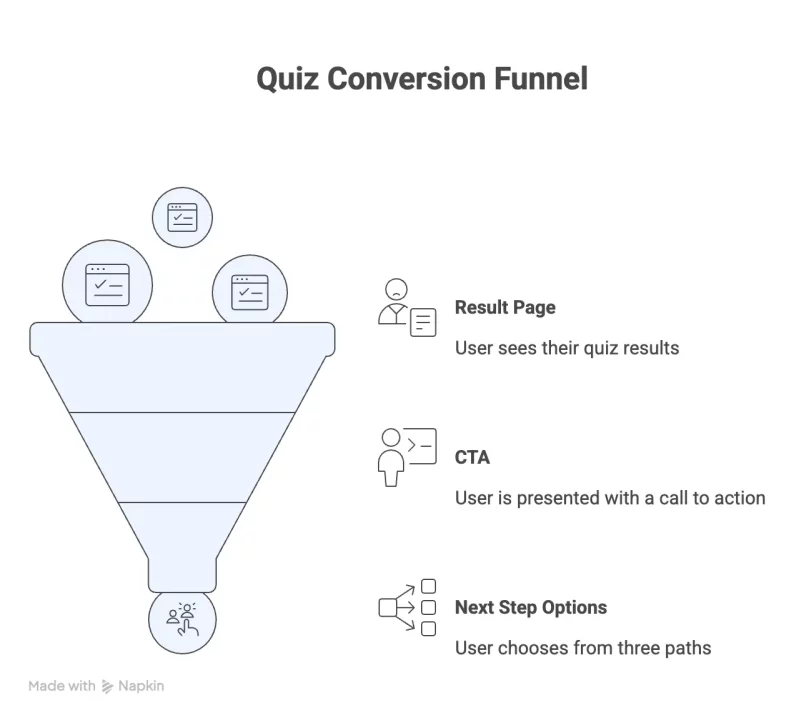
Whether they click, sign up, or buy comes down to one thing: the quiz results section.
A quiz result that lands well does two things:
- It confirms something the user already suspected about themselves,
- It frames that confirmation in a way that feels specific and earned.
A quiz without a strong result is just entertainment. The user finishes, feels mildly curious about their outcome, and moves on. Nothing captured, nothing converted.
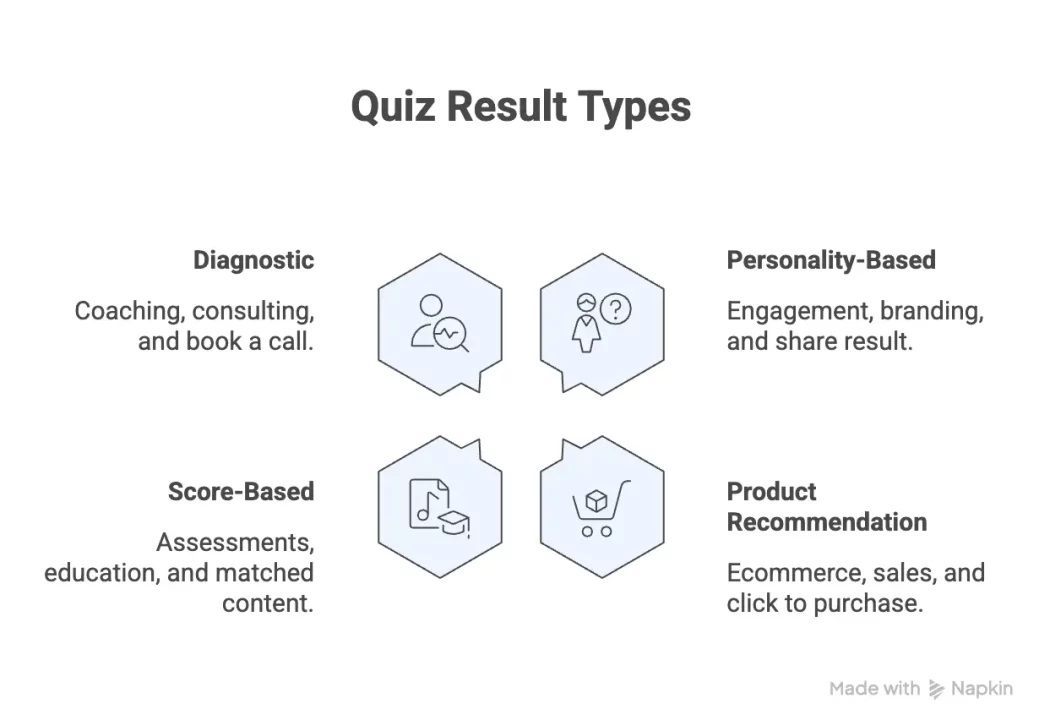
Types of Quiz Results and When to Use Them
Personality-Based Results
Personality results assign the user a type or label: “You’re The Strategist.” “You’re a Collaborative Thinker.” The result describes who the user is rather than what they should do.
When the label feels accurate, users share it because it says something about them. A screenshot posted to Instagram Stories or sent in a group chat takes only 2 seconds and conveys something personal without requiring the user to write anything.
This format produces Buzzfeed-style personality quizzes that have high share rates and work best at the top of the funnel, where the goal is reach and brand recall rather than immediate conversion.
Product Recommendation Results
Instead of browsing a catalog, the user is told what fits their situation.
For instance, a skincare brand routes oily-skin answers to one product and dry-skin answers to another, with a direct purchase link on the result page. A supplement brand does the same: answers about energy, sleep, or recovery map to specific products rather than a generic shop page.
The format works best when you have three or more distinct product tiers or categories, each suited to a different type of buyer.
Score-Based Results
Score-based results place the user on a spectrum: “You scored 72 out of 100” or “You’re at an intermediate level.”
This format works best for assessments and educational content where users want to benchmark themselves. The follow-up action is typically a guide, a course, or a resource matched to their level.
Diagnostic Results
Diagnostic results name a specific problem: “Your biggest bottleneck is client acquisition” or “Your current approach is reactive rather than strategic.”
This format works best for coaches, consultants, and service providers whose audience is already problem-aware. The natural next step is a discovery call or a high-ticket offer.
What a High-Converting Quiz Result Must Include
The result page has one job: give the user something specific enough to act on. I generally depend on these 3 elements.
1. Clear Outcome Explanation
Tell the user what their result means in specific terms, connected to why they took the quiz. “You’re a creative thinker” is not an explanation. “You process information by generating options rather than evaluating them, which makes you strong in early-stage problem solving and weaker in execution.”
2. Personalization
Write a result copy that speaks to the user’s situation, not a category. Use second person throughout and reference their answers, even implicitly. For instance, “If you tend to start projects with energy and lose momentum mid-way, this result reflects exactly that pattern.” The result should feel written for them, not assigned to them.
3. One Clear Next Step
Every result page needs one call to action. If the result identifies a problem, the CTA offers a solution. If it assigns a type, the CTA offers something tailored to that type. A leadership quiz that says “You’re a Visionary” should be followed by “Get the Visionary’s guide to building a team around your strengths,” not a generic “Subscribe to our newsletter.”
Two or three CTAs produce the same outcome as none: the user reads everything and clicks nothing.
How to Turn Quiz Results Into Clicks, Leads, and Sales
The goal the quiz serves determines what the result page should prioritize.
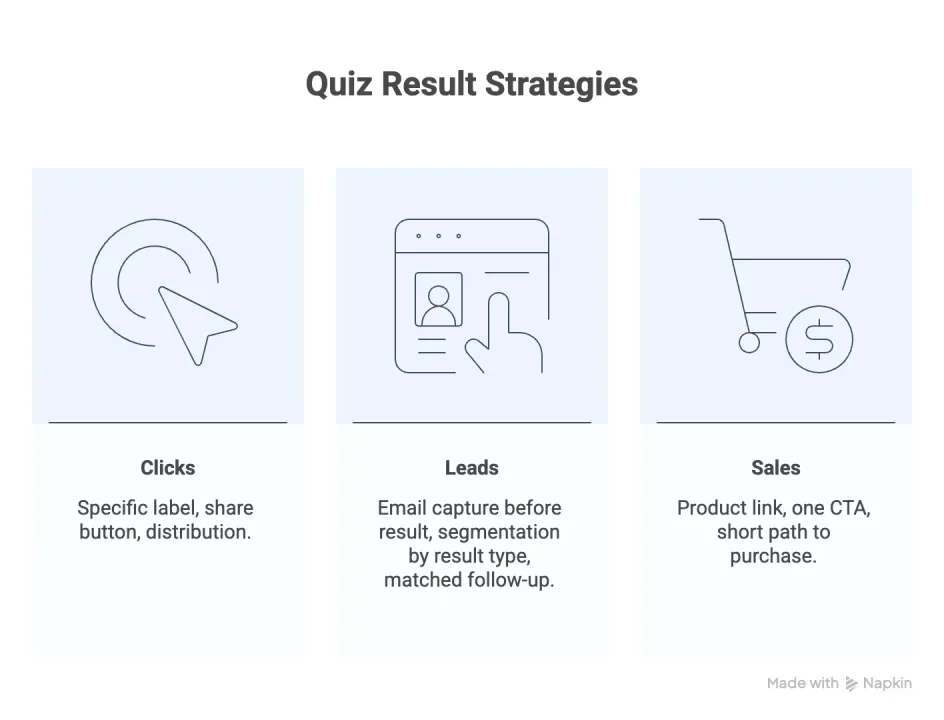
For Clicks
Write the result copy that users want to screenshot and share: a specific label and a description that makes them feel accurately seen. Add a share button directly on the result page, and keep the CTA to a single action. The goal here is distribution and more visibility.
For Leads
The result page is the most effective place to capture leads because the user has already committed to the experience. Place the email capture just before the result is revealed and gate the result behind it. At this point, the user has answered every question and wants to see their outcome, which makes them willing to exchange an email for it.
Tag each submission by result type in your email platform so each segment receives follow-up content matched to their result rather than a generic welcome email. This is what boosts lead quality: you’re not just collecting emails, you’re collecting emails with context.
A quiz with four result types gives you four distinct audience segments from a single piece of content, which is what makes a well-designed quiz lead magnet more effective than a standard opt-in form.
For Sales
Sales happen when the result page removes the decision the buyer would otherwise have to make themselves. Include a specific product link, a service CTA, or a booking prompt matched to the result. Every additional element between the result and the action reduces the conversion rate.
The formats that drive sales most directly are those where each result maps to a specific product or service rather than a general shop page, such as personality quizzes that sell products and product recommendation quizzes.
Strong vs. Weak Quiz Results
The biggest difference between a result that converts and one that doesn’t comes down to specificity. A weak result could apply to anyone. A strong result could only apply to the person reading it.
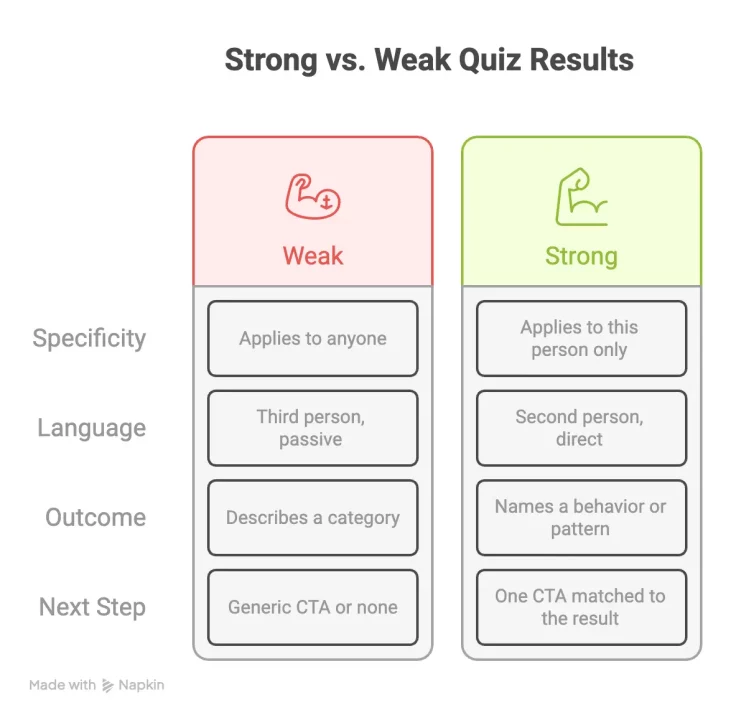
Weak: “You’re creative and enjoy helping others.”
Strong: “You’re The Connector. You do your best thinking in conversation, which means solo brainstorming drains you faster than it produces ideas.”
Weak: “Your business has room to grow in several areas.”
Strong: “Your biggest growth constraint is lead generation, not conversion. You’re closing well but not filling the top of your funnel consistently enough.”
Weak: “Explore our pro plan.”
Strong: “Your answers point to the Pro plan. You need automated reporting and multi-user access, and the Starter plan will create friction within the first month.”
The strong results share one thing: the user learns something specific that they couldn’t have arrived at without taking the quiz.
Designing Quiz Results That Guide User Decisions
The most common result page mistake is trying to say too much. A long result page with multiple sections, several resource links, and two or three CTAs produces decision paralysis. The user reads everything, clicks nothing, and leaves.
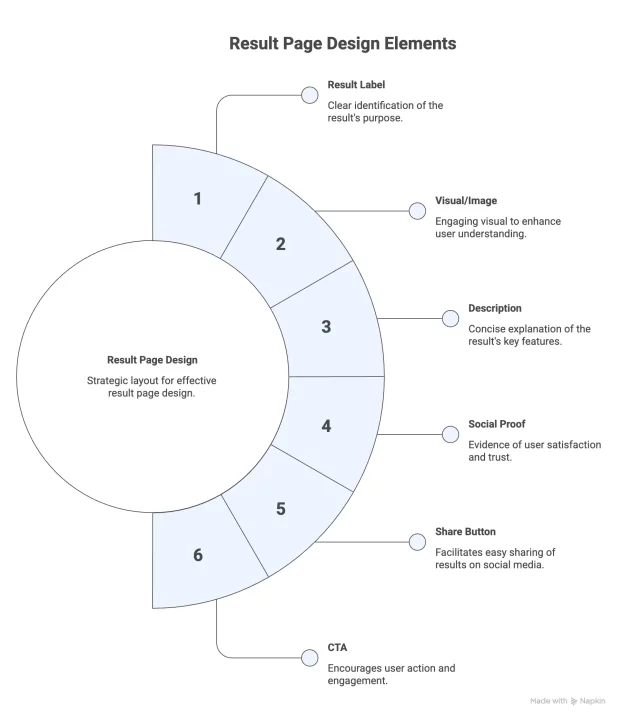
Keep the page to three content elements in order:
- What the result means for the user specifically
- Why is it accurate based on their answers
- One action to take next
Beyond copy, the design of the result page affects whether the user trusts the result and acts on it. A few elements that consistently matter:
- Branding: A result page that matches your brand’s colors, fonts, and tone builds trust before the user reads a word. A generic-looking result page undermines the credibility of whatever it says.
- Visuals: An image or illustration tied to the result type makes the outcome feel more distinct and shareable. Users are more likely to screenshot a result that looks designed than one that’s plain text.
- Share options: A share button on the result page removes the friction of copying and pasting. Place it directly below the result description, before the CTA.
- Mobile layout: Most quizzes are completed on mobile. A result page that requires scrolling past three sections to reach the CTA loses users before they get there.
- Result label prominence: The label, “You’re The Connector” or “You’re at an intermediate level,” should be the first thing the user sees. If it’s buried below a paragraph of explanation, the emotional payoff lands too late.
- Result page URL: A unique, shareable URL for each result type lets users bookmark and share their results directly. A result that only exists as a session state can’t be shared or revisited.
- Social proof on the result page: Showing how many people got the same result (“You’re one of 12,000 Connectors”) adds credibility without requiring the user to read more. One line, placed below the label.
- Tone consistency: The result copy should match the tone of the quiz questions. A quiz that uses casual, conversational language and then delivers a formal, clinical result creates a disconnect that undermines trust in the outcome.
Tools and Features That Help You Build Better Quiz Results
Building result pages that feel specific, personalized, and actionable requires more control than most basic quiz tools offer. Tools like Quiz and Survey Master (QSM) give you that control with features like:
- Conditional logic: Shows different content based on specific answer combinations, which separates a result that feels precise from one that feels generic.
- Answer mapping: Connects individual responses to weighted outcomes, so the result reflects the full pattern of answers rather than a broad category.
- Custom result pages: Each outcome gets its own page, copy, and CTA rather than a one-size-fits-all prompt.
- Email integrations: Pass result data directly to your email platform, tagged by outcome, so segmentation happens at the point of capture without manual sorting.
Button: [Create your quiz and results using QSM]
How Quiz Results Fit Into Your Funnel
Every result routes the user to a specific next step: a sequence, a product, or an offer. Where they go determines whether the quiz generates a lead, a sale, or just a completed interaction. That destination should be decided before you write a single result page.
- Personality quiz: Routes into a broad welcome sequence that introduces your brand and content.
- Diagnostic quiz: Routes into a follow-up sequence that addresses the specific gap the quiz identified.
- Product recommendation quiz: Routes into a purchase flow, with the result page telling the user why this product fits their situation rather than sending them to a generic listing page.
- Assessment quiz: Routes into a content sequence matched to the user’s level. A beginner gets foundational content. An advanced user gets a higher-tier offer.
- Score-based quiz: Routes into a sequence based on where the user scored. Low scorers get educational content. High scorers get a direct offer or a discovery call.
Each of these routes is what separates a quiz funnel from a quiz that just collects completions. Setting them up correctly on WordPress requires a quiz plugin that gives you routing control at the result level, not just at the quiz level.
Common Mistakes That Kill Quiz Conversions
Generic results. A result that could apply to half your audience isn’t a result. The user reads it, feels nothing in particular, and leaves without taking action.
No personalization. Writing in third person or passive voice creates distance between the result and the reader. Second person and specific language close that distance.
Too much text. A result page that requires five minutes to read loses the user before they reach the CTA. Keep it to an outcome explanation, one or two supporting sentences, and one CTA.
A CTA that doesn’t match the result. A result that identifies a problem and then offers a generic newsletter signup wastes the segmentation the quiz just produced. The next step should follow directly from what the result said.
Start Improving Your Quiz Results Today
The questions bring users to the result page. What happens there determines whether the quiz generates a lead, a sale, or nothing at all. A specific result, a CTA that follows from what it says, and a clear route into your funnel are the three things that separate a quiz that converts from one that just gets completed.
The result page is also the easiest part of the quiz to fix. The questions, the flow, and the design can stay exactly as they are. Start with your weakest result, rewrite it for one specific type of person, and add one next step that makes sense for what it says.