A quiz that captures leads, engages readers, and tests knowledge? That’s a yes, and it can be live on your site by the time you finish this article.
There are plenty of quiz plugins in the WordPress ecosystem and several ways to build one, but this guide uses the Quiz and Survey Master plugin to walk you through it, no code, no developer, and no paid plan required (unless you need advanced add-ons).
Stick with us and you’ll go from a blank page to a working quiz published live on your site, start to finish.
Table of Contents
Why Add a Quiz to Your WordPress?
It’s no secret that interactive content pulls more weight than static content. It can drive far more engagement per pageview, and visual interactive formats like quizzes or polls are 20-40 times more likely to be shared on social networks than passive content.
That’s the short version of why you must add a quiz to your website; however, let’s highlight more benefits of it.
- Engagement & time-on-page: 81% marketers agree that interactive content like puzzles, quizzes, or games grabs attention better than static formats. And the longer someone stays inside a quiz, the longer they stay on your site.
- Lead generation: An ideal quiz delivers personalized value with low upfront friction. Once someone’s invested in their result, handing over an email to see it feels like a fair trade. And that gives you a segmented list you can drop into targeted email funnels.
- Audience Insight: A 10-sec poll or feedback quiz can tell you things about your audience you’d never learn from a contact form or long surveys. It further fuels sharper personalization later.
- Educate or assess: Quizzes are great for engagement, but they aren’t just for fun. You can use them to test knowledge, reinforce a lesson, run a course assessment, or even deliver a graded online exam.
What to look for in a WordPress quiz plugin?
When you have to put your energy, time, and money into something, then a lot goes into a decision. We are saving you that time and money by giving you a short checklist of what to look for when trying a quiz plugin.
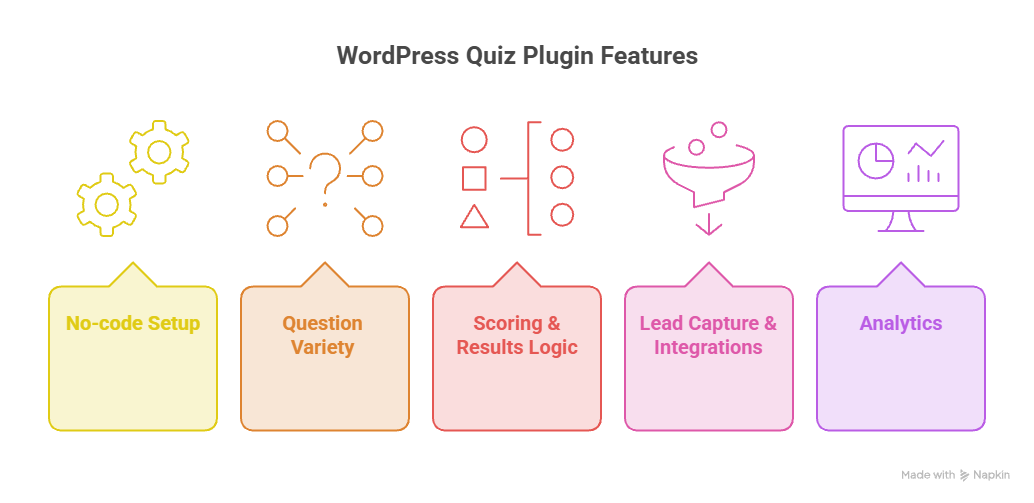
1. No-code setup: We started the article with the title that mentions “no-code,” so it is necessary to see that the plugin you use doesn’t give you an interface where coding is required. Besides, from our experience, a lot of plugins are no-code zones, so you get a lot of options to try from.
2. Question variety: It’s not enough to have just multiple-choice types. A good quiz plugin should and will let you mix question types for different requirements. Like dropdown, short answer, checkbox, file upload, and radio-button questions, so the same tool can build a personality quiz today and a serious graded exam tomorrow. QSM helps with all of these out of the box.
3. Scoring & results logic: Quizzes in most of the cases fall into two camps — graded (right/wrong, with a score) and outcome-based (personality-style results like ‘you’re a genius’). The plugin you pick should handle both, let you assign points, and show a tailored result page according to how someone answered.
4. Lead capture & integrations: A quiz that can’t capture a lead is just a form (not personalized enough). Look for the ability to add contact fields (name, email) before showing results and, just as important, to send that data somewhere useful automatically. Native connections to email tools and CRMs like Mailchimp, ActiveCampaign, Google Sheets, or Zapier mean every quiz taker flows straight into your follow-up funnel.
5. Analytics: Building the quiz is half the job; knowing whether it actually works is the other half. Your plugin should show you the numbers that matter: how many people started vs. finished, where they dropped off, and how they answered, so you can tweak weak questions instead of guessing.
The best part, Quiz and Survey Master, checks every box on this checklist, and it’s free to start. So, you can install and build a quiz (no matter how basic or short) immediately.
But first, go through the steps to create a quiz using the plugin.
How to create a quiz in WordPress with QSM (step-by-step)
Before starting the first step, make sure you have your QSM plugin installed in your WordPress dashboard.
Now that you have installed the plugin, let’s get you to create the first quiz for your site.
Step 1: Create a New Quiz
Head to the QSM dashboard and click Get Started. Then select Quiz as your type.
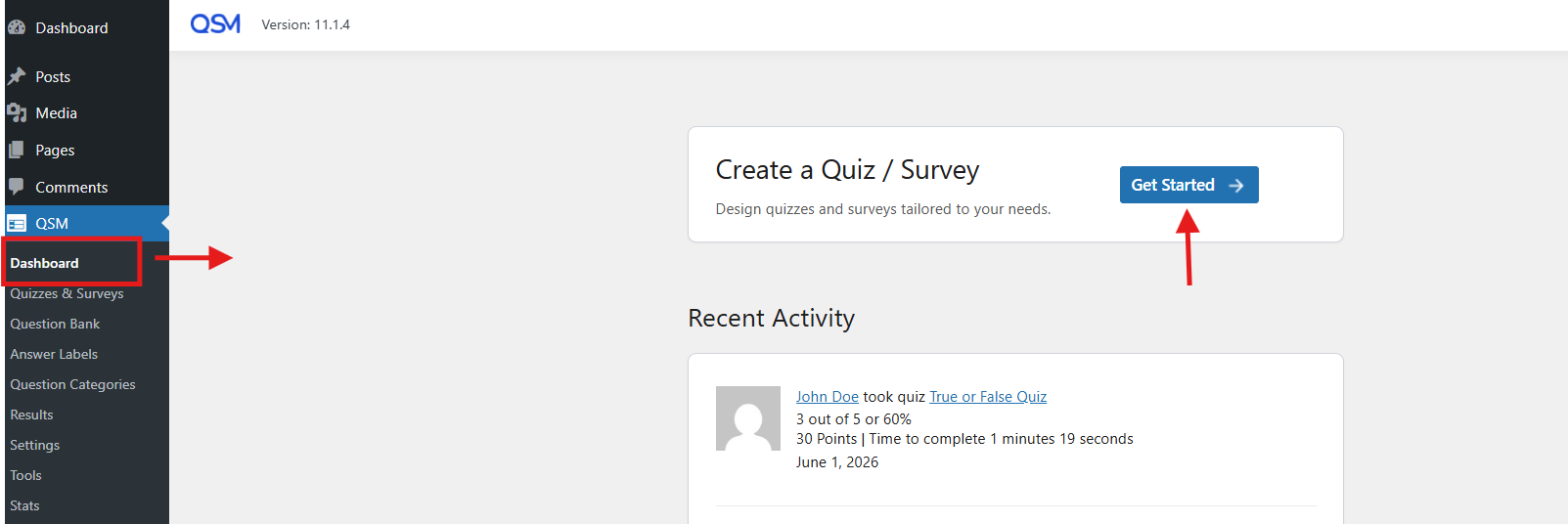
You’ll land on a quick setup flow:
1. Pick a theme. The default theme is selected for you and works perfectly for a free, no-code quiz. (Other themes are premium — but you don’t need one to get started.)
2. Add an add-on (optional). QSM offers 40+ paid add-ons for things like AI question generation, webhooks, and Mailchimp integration. If one fits your goal, add it here; if not, skip it and move on.
3. Name your quiz. Give it a clear title so you can find it later.
4. Configure the basics (optional). Right here, you can switch on grading, a progress bar, a user-login requirement, a time limit, and more, or leave them for now and set them up inside the quiz later.
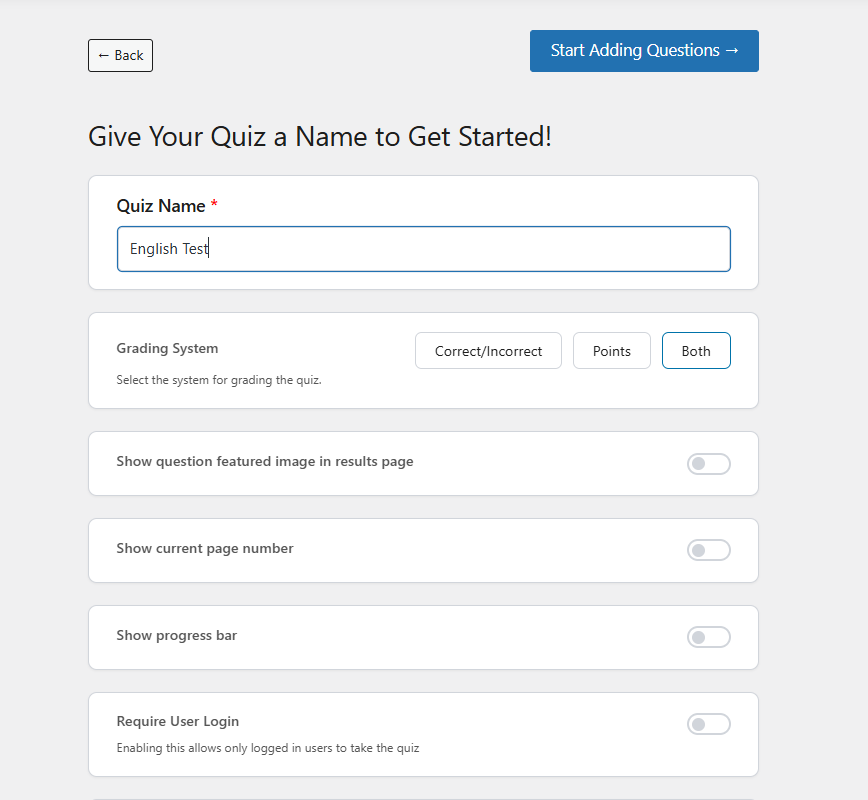
When you’re done, click Start adding questions. This drops you into QSM’s main tab interface, where the rest of the work happens.
Step 2: Add questions and answers
You’ll open straight into the Questions tab with a default question editor ready to go.
For each question:
1. Type your question and, if you want, add a description for extra context.
2. Choose a question type — multiple choice, true/false, fill-in-the-blank, and more.
3. Add your answers. For multiple choice, enter each answer option. If your grading is set to both points and correct/incorrect, assign points to the right answer and mark it as correct.
4. Pick an answer format. Answers don’t have to be plain text — you can switch to text + image, or image-only answers for a more visual quiz.
5. Save the question before moving on.
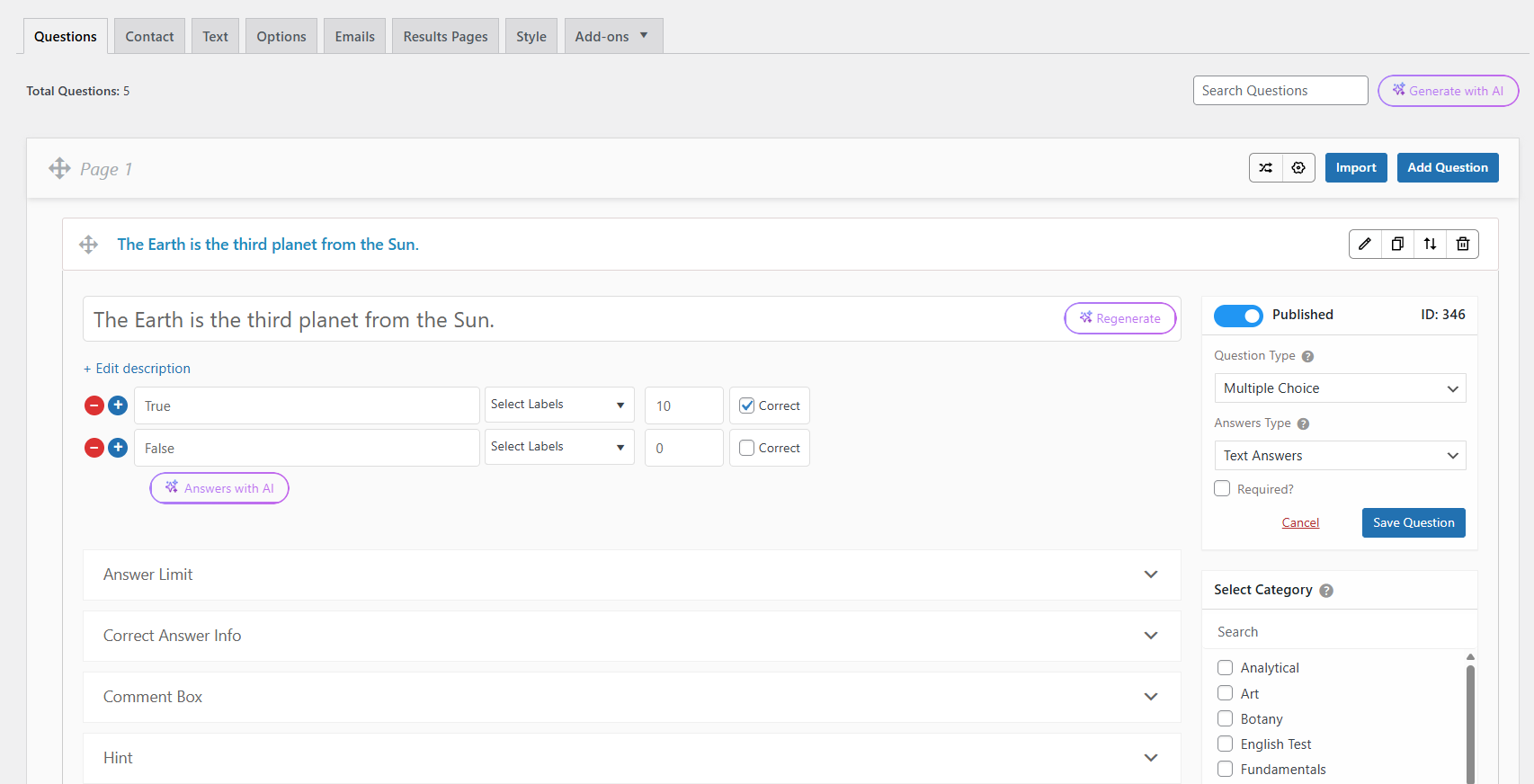
Repeat to add as many questions as you need. You can keep them all on one page or split them across multiple pages, which is handy if you want your quiz to feel like separate sections for the people taking it.
Shortcut — AI question generation (paid add-on): If you’ve added the AI integration add-on, you can skip manual entry. Just give it a topic or prompt and set a few basics, like question type, difficulty, whether answers are graded, number of questions, and how they’re paged, and it’ll generate the full set in under a minute.
Step 3: Configure quiz settings and behavior
This is where you shape how the quiz actually behaves for your audience.
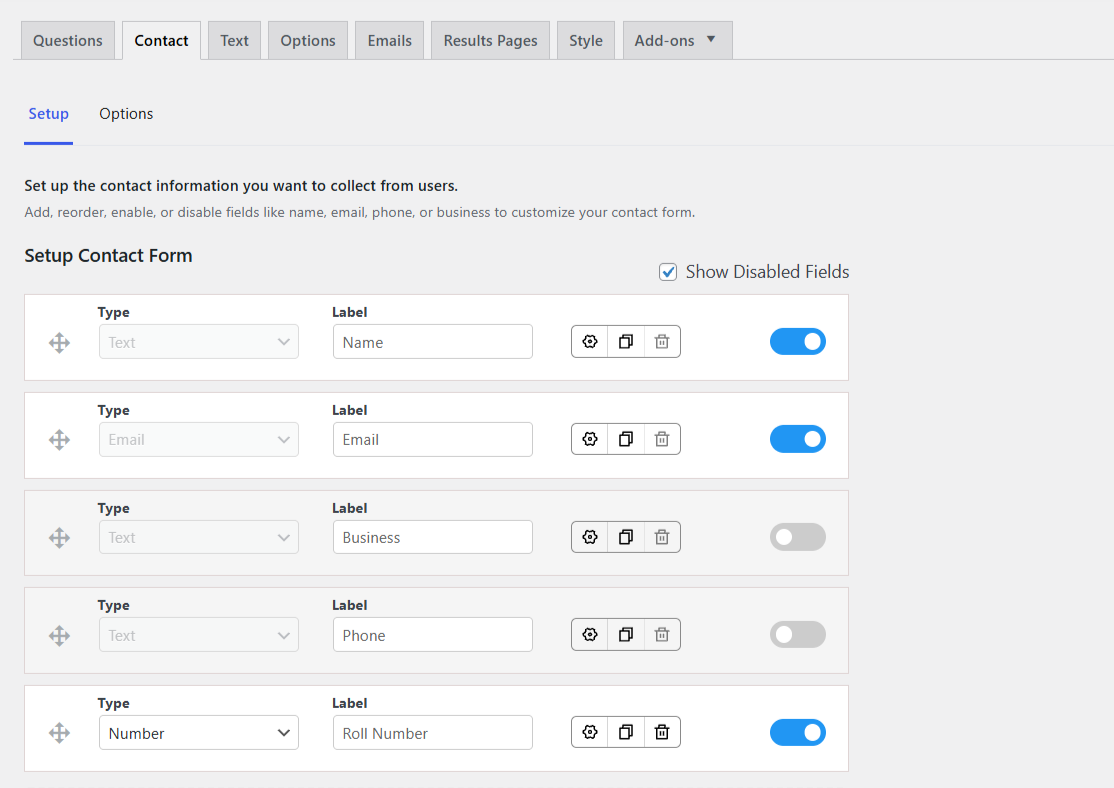
Set up your contact form (key for lead generation).
Under the Contact tab, choose what information you want from people before they see their results, usually name and email. You can enable the default fields, tweak them, or create new contact fields for specific purposes, for example, a checkbox or radio button with a disclaimer that ticking it opts the user into your newsletter.
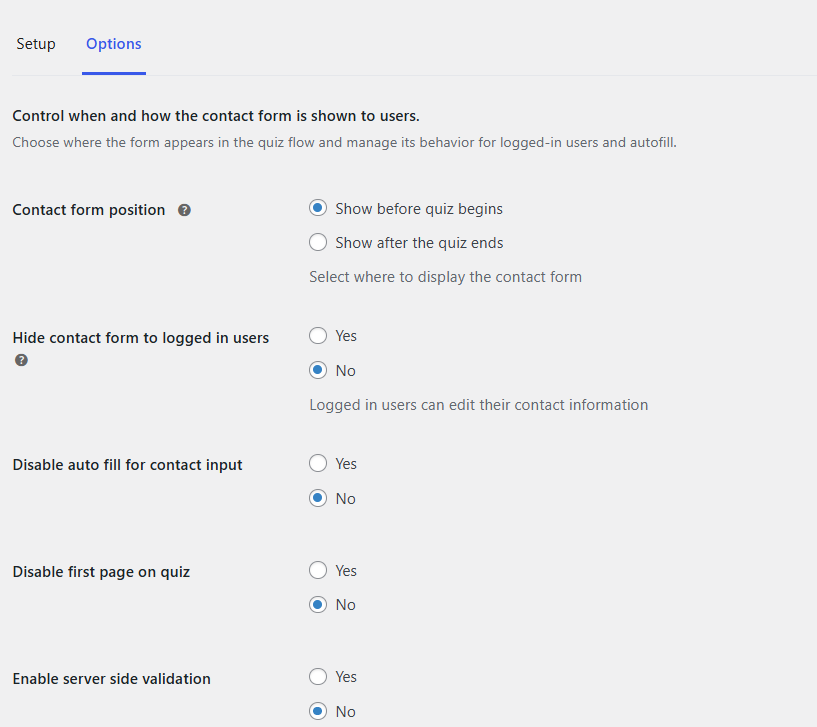
Still in the Contact options, decide how and when the form appears:
- Show it before or after the quiz
- Turn on server-side validation
- Disable the first page if needed
- Add error messages for blank required fields or invalid email addresses
Under the Options tab of QSM
Control access and submissions.
- Restrict the quiz to logged-in users only (if you didn’t already enable user access during setup)
- Set a time limit to complete the quiz
- Cap the number of attempts per person or the total number of respondents
Tune the on-page experience.
- Show a progress bar
- Set how many questions appear per page
- Enable auto-pagination and a per-page timer
With your settings dialed in, your quiz logic is done; next, you’ll get it customize the outcome, which is results and email templates.
Step 4: Set up emails, results, and integrations
Now you’ll decide what people see and what lands in their inbox, based on how they did.
Automate your emails.
Open the Email tab. This is where you set up emails that fire automatically based on quiz behavior and results. Each email template has two halves:
1. The condition (left side): Decide when this email should be sent, based on a quiz category, a chosen option, a total point value, or a correct-answer percentage.
2. The email itself (right side): Define who receives it, the subject line, and the content.
Example: set the condition to total points = 20, and everyone who scores 20 gets that specific email.
You can stack multiple templates, one for each score band or outcome — so a high scorer and a low scorer receive completely different messages.
Build your results page.
Setting up the Results page works almost exactly like the email templates. Whatever you configure here is what shows on screen the moment someone submits the quiz.
1. Set a condition, then build the message for it — start from scratch or use one of QSM’s ready-made templates.
2. Prefer not to design a results page at all? You can redirect users to a different URL when the conditions are met instead.
3. Save the results page when you’re done.
And that’s your quiz, fully built with questions, logic, emails, and results all in place. Now there’s just one thing left: getting it live on your site.
Push results into your marketing tools (optional add-on).
If you’ve added an integration like Mailchimp or ActiveCampaign, you’ll see a checkbox and a few settings from the add-on tab.
Tick it, configure it, and whenever the result conditions are met, the contact fires straight into your email automation tool, so quiz takers flow into the right list or funnel without any manual export.
Step 5: Publish your quiz on your WordPress site
Your quiz is built — now let’s get it live. QSM gives you two ways to do it. Pick whichever you’re comfortable with.
Option 1 — The QSM block (easiest, no code).
1. Go to Pages → Add New (or open an existing page).
2. Add a new block and search for the QSM block.
3. Select it, then choose the quiz you just created from the dropdown.
4. The quiz drops straight into your page. Hit Publish, and it’s live.
Option 2 — Shortcode or embed.
1. Go to QSM → Quizzes & Surveys.
2. Find your quiz in the list and grab its shortcode (you’ll also see link and iframe/embed options next to it.
3. Copy it, then paste it into any WordPress page or post.
4. Publish the page, and your quiz appears right where you placed it.
Either way, the result is the same: a fully working quiz, live on your site, built without a single line of code or a developer in sight.
Tips to get more from your WordPress quiz
Building the quiz is the easy part; getting people to finish it (and act on it) is where the real wins are. A few quick things that make a big difference:
1. Keep questions short and skimmable: Long, wordy questions kill momentum. Aim for one clear idea per question, and lean on image answers where they make the choice faster to grasp.
2. Design for completion: Use a progress bar so people can see the finish line, break longer quizzes into pages, and keep the total length honest to the promise — a “2-minute quiz” should actually take two minutes only.
3. Gate the results to capture leads: The moment someone is invested in their outcome is the moment they will happily share their contact details, like email, to see it. Put your contact form right before your results page, not buried up front.
Read how to create results that convert → Quiz Results That Convert: How to Turn Outcomes Into Clicks, Leads, and Sales
4. Always show a personalized result: A generic “thanks for completing the quiz” wastes the most valuable screen in the whole experience. Use conditional results so a different response category gets a message that actually speaks to them.
5. Track, then tweak: Check your completion rate and where people drop off. If everyone bails on question 4, that’s the question to fix — not guess.
You’re ready to publish your first WordPress quiz
That’s it, you’ve gone from a blank canvas to a working quiz, complete with questions, scoring, automated emails, and a result page, all live on your site without a line of code or a developer.
The best way to get comfortable is to build one.
Download Quiz and Survey Master free → and have your first quiz live in the next few minutes.
When you’re ready for more, check out all the add-ons that QSM provides — AI Integration, certificate, gamify, webhooks, and more — Explore QSM’s plans and add-ons→
And this is just the start. Decide what to build next: a lead generation quiz, a personality quiz, or a secure online exam. Each one is a new way to turn passive visitors into engaged, segmented subscribers.