Most marketers still rely on static forms or landing pages to collect leads. These methods capture email addresses, but they offer very little insight into who the lead is or what they are looking for. That information usually has to be figured out later through manual follow-ups or broad email campaigns.
A quiz funnel in WordPress adds structure to this process. Instead of asking for an email upfront, it starts with a few focused questions. The answers help identify intent, stage, and needs before the lead enters your email tool or CRM. This makes it easier to segment users.
In this guide, we’ll walk through how a quiz funnel in WordPress works and how to build a quiz funnel step by step in WordPress. We’ll also cover how to connect your quiz to email tools and automation platforms like Zapier or webhooks, so quiz data can trigger tags, workflows, and follow-ups automatically across your existing systems.
Table of Contents
What a Quiz Funnel Actually Is
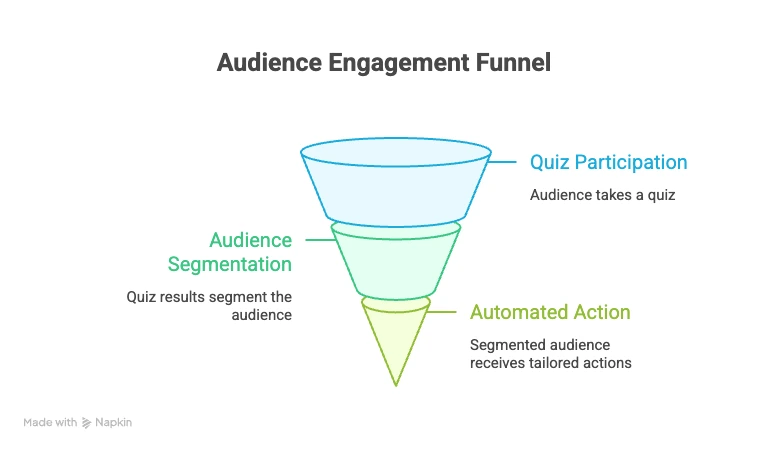
A quiz funnel is more than a standalone quiz. It functions as a system that connects traffic, questions, segmentation, and automation into a single flow.
In practical terms:
- Traffic comes from ads, blog posts, or social media
- Visitors answer questions that indicate intent or needs
- Answers are used to segment users
- Each segment triggers a specific follow-up or workflow
This setup allows you to capture lead data before collecting an email address and use that data to guide what happens next. Follow-ups can be adjusted based on answers instead of being sent uniformly to every lead. This system-first approach is central to quiz funnel marketing.
There are several types of quiz funnels:
- Lead generation: Capture emails by offering results via the inbox
- Product recommendation: Suggest products based on user preferences
- Personality segmentation: Categorize users into types for targeted messaging
- Educational or assessment: Evaluate knowledge or needs before offering next steps
If you’re planning to use a quiz at the top of your funnel, this guide on using quizzes as lead magnets explains how quizzes fit earlier in the lead capture process: Quiz Lead Magnet.
How a Quiz Funnel Works (Step by Step)
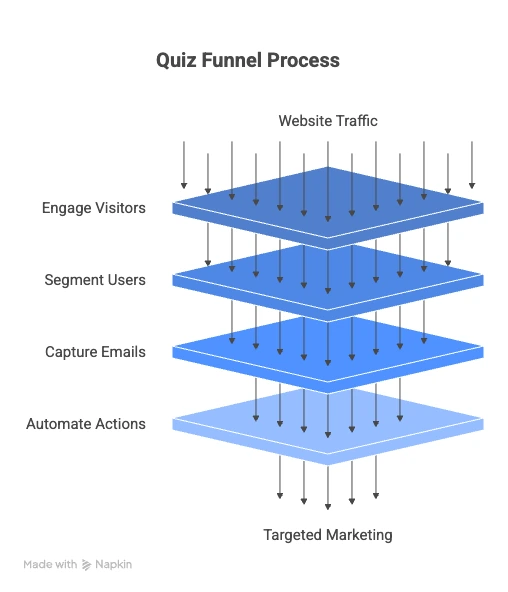
A quiz funnel in WordPress follows a clear sequence. Each step has a specific role in capturing, segmenting, and automating leads without adding friction for the user.
Step 1: Bring Visitors to the Quiz
Every quiz funnel starts with traffic. This traffic can come from blog posts, paid ads, email campaigns, or social media. Instead of sending users to a form or generic landing page, you send them directly to the quiz.
At this stage, the goal is simple: get the right audience to start the quiz. Since the quiz is positioned as a short interaction, users are more likely to engage compared to filling out a long form. This is the entry point of quiz funnel marketing.
Step 2: Segment Users with Smart Questions
Once users start the quiz, the focus shifts to segmentation. The questions are designed to understand intent, needs, and readiness. These are not random or entertaining questions. Each answer should help place the user into a meaningful segment.
For example, questions about goals, timelines, or past experience help determine whether someone is just exploring or actively looking for a solution. This step is central to quiz segmentation and decides how the rest of the funnel behaves.
Step 3: Capture Email Where It Makes Sense
After collecting enough context, the quiz asks for an email address. At this point, users have already answered questions and understand why the opt-in is relevant.
This approach usually leads to better opt-in rates and higher-quality leads. Instead of collecting an email upfront, the quiz funnel captures information first and then requests contact details based on that interaction. This structure is commonly used in high-performing quiz funnel WordPress setups.
Step 4: Automate What Happens After Opt-In
Once the email is submitted, automation takes over. Based on quiz answers, users can be tagged, added to specific lists, or pushed into different email sequences. This is where quiz automation becomes critical.
Using email integrations, Zapier, or webhooks, the quiz funnel can trigger actions such as assigning CRM fields, starting a follow-up sequence, or sending data to other tools. Each segment moves forward with messaging and actions that match their inputs, allowing teams to automate quiz funnel workflows reliably.
Together, these steps form a complete automated quiz funnel that captures leads, segments them accurately, and connects directly to your marketing systems.
Questions Logic That Helps Build Funnels
When building a quiz funnel, it’s important to avoid trivia-style questions. The goal is not to test knowledge or entertain, but to understand intent. Questions should help with quiz segmentation and support quiz automation by shaping what happens after the quiz is completed.
Each question should have a clear purpose. If an answer does not affect tagging, follow-ups, or workflows, it usually does not belong in a quiz funnel WordPress setup.
Below are three question types that consistently work well in quiz funnel marketing, along with practical examples.
Problem Awareness
These questions help identify how clearly the user understands their problem. This information helps decide whether they need educational content or a more direct next step. Example questions:
- “What best describes the challenge you are facing right now?”
- “How clear are you about the solution you need?”
- “Which statement feels closest to your current situation?”
Stage in the Buying Process
These questions focus on timing and readiness. They help separate early interest from users who are closer to taking action. Example questions:
- “When are you planning to take action?”
- “Which option best describes where you are right now?”
- “Are you actively comparing solutions or still researching?”
Budget Range
Budget questions help align offers and messaging without pushing users. Broad ranges usually work better than exact numbers. Example questions:
- “Which budget range feels realistic for you right now?”
- “How are you planning to invest in a solution?”
- “What level of spend are you comfortable exploring?”
Integrations and Automation
This is the stage where a quiz funnel gets connected to your marketing tools. After a user completes the quiz and submits their email, QSM sends quiz data to other systems so follow-ups can happen automatically.
In a quiz funnel WordPress setup, QSM works as the connector between the quiz and tools like email platforms or automation services.
Step 1: Connect an Email Tool in QSM
QSM connects to email platforms using add-ons. These add-ons allow quiz data to be sent outside WordPress when a user submits the quiz.
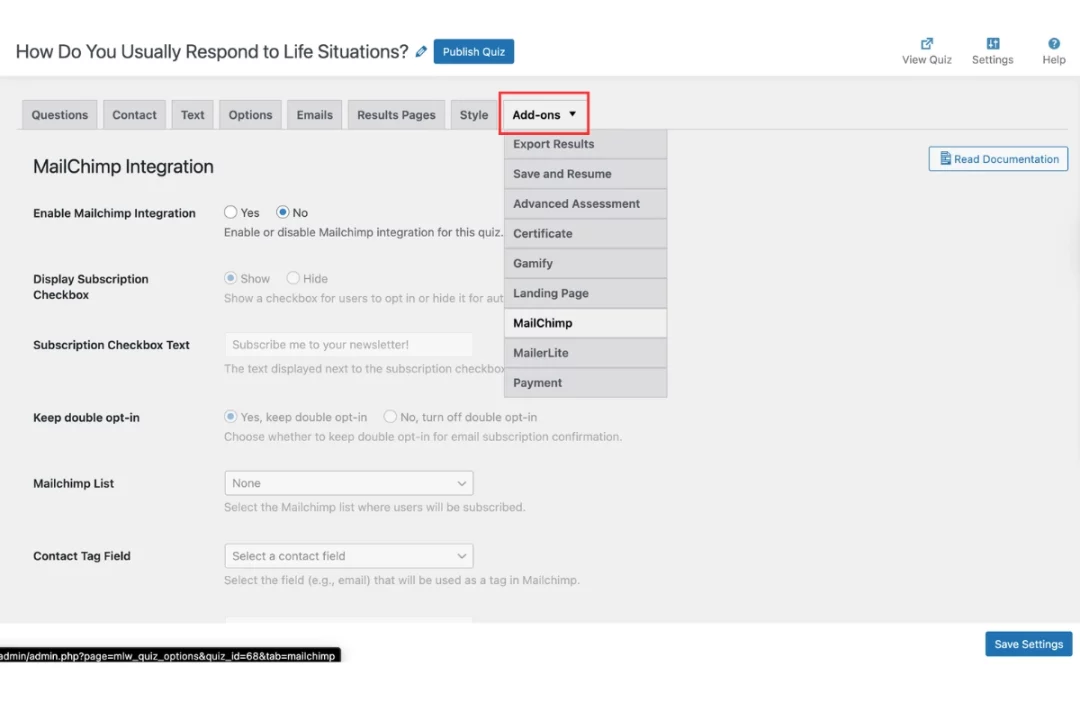
Common email tools used with QSM include Mailchimp, ActiveCampaign, and GetResponse to boost email marketing efforts. Once an integration is enabled, QSM can send contact details such as email address and name, along with quiz-related data like score or selected answers.
This step is mainly about enabling the connection and setting basic subscription rules.
Step 2: Use Quiz Data for Segmentation (Mailchimp, ActiveCampaign, GetResponse)
Once the email tool is connected, QSM allows quiz data to control how leads are grouped inside that tool. This is where the funnel logic starts working.
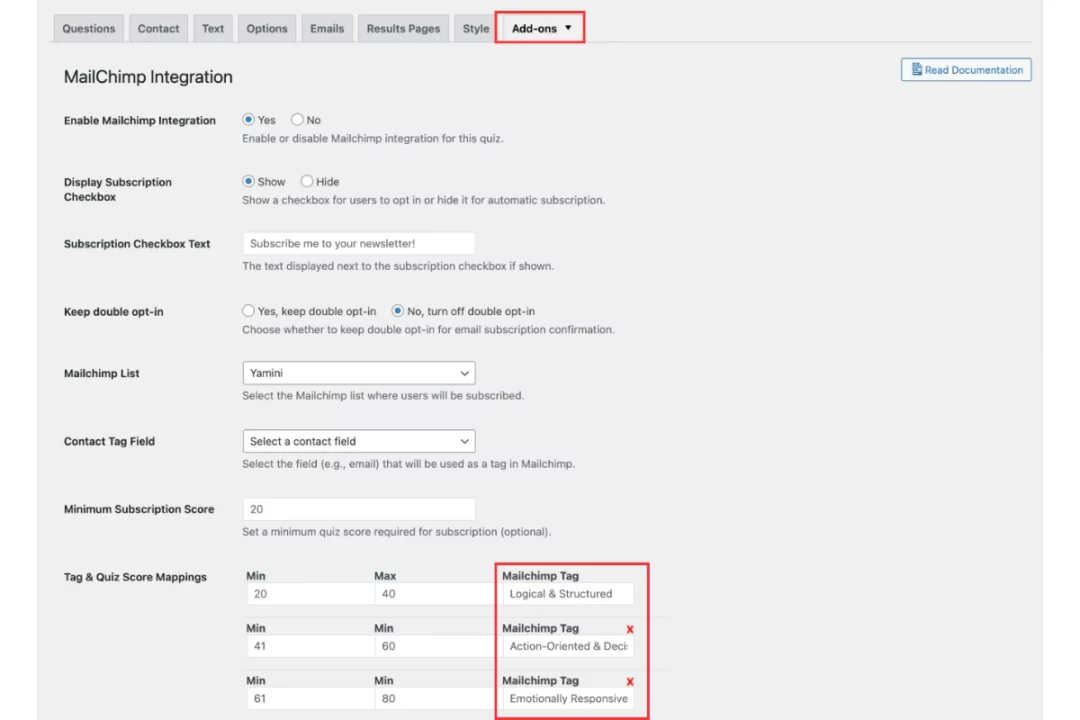
How segmentation works depends on the integration:
- Mailchimp: QSM can send quiz scores and contact details using merge fields. Quiz scores can also be used to apply tags based on score ranges. This helps separate leads based on outcome or level.
- ActiveCampaign: QSM allows deeper segmentation. Selected quiz answers can be reflected as tags, quiz scores can map to tags, and specific questions can be sent to custom fields. This works well when different answers need different follow-ups.
- GetResponse: QSM focuses on list-based segmentation. Quiz takers are added to selected lists, with control over whether subscription is automatic or optional.
For example:
- A quiz includes a question about the user’s goal
- One answer indicates “Needs strategy help”
- That response is stored in the email tool as a tag, field, or list placement
This step ensures leads are labeled correctly as soon as they enter your system.
Step 3: Trigger Follow-Up Workflows Based on Segments
After segmentation is set, follow-ups are handled inside the email platform.
Email tools use the data sent by QSM to:
- Start email sequences
- Send different content to different segments
- Route leads into separate workflows
For instance:
- A tag added by QSM triggers a specific email sequence
- A different tag triggers a different follow-up path
This step is where quiz funnel marketing becomes useful. Follow-ups are based on quiz inputs, not sent the same way to every lead.
Step 4: Extend Automation with Zapier or Webhooks
If your Quiz Funnel in WordPress needs to connect to tools beyond email platforms, QSM can also send quiz data using Zapier or webhooks. This makes it easier to automate quiz funnel actions across CRMs and internal systems.
Common use cases include:
- Sending quiz results to a CRM
- Creating entries in Google Sheets
In these setups, QSM still acts as the input layer, while Zapier or the webhook handles actions in other tools.
Watch how to set up Zapier Integration using QSM.
What to Track to Know It Works
Once your quiz funnel is live, tracking the right metrics helps you judge performance and make improvements. These are the key benchmarks marketers should monitor.
- Quiz start vs finish rate: Shows how many users who start the quiz actually complete it. A low finish rate usually points to friction, unclear questions, or a quiz that feels too long.
- Opt-in rate: Measures how many quiz takers submit their email after completing the quiz. This helps assess lead quality and whether the opt-in is placed at the right point in the funnel.
- Conversion rate to the first CTA or content download: Tracks how many leads take the next action after the quiz, such as downloading a resource or booking a call. This metric reflects how well quiz results and CTAs align with user intent.
- Email flow engagement: Includes open rates, click-through rates, and replies for email sequences triggered by quiz segments. This shows whether follow-up content matches what users shared in the quiz.
- Revenue per lead: Connects quiz leads to actual business outcomes. This helps compare quiz funnel performance with other lead generation methods.
These metrics give a clear view of whether your quiz funnel is capturing the right leads and moving them forward effectively.
Compare quiz funnel tools & choose the best fit.
Common Funnel Mistakes to Avoid
These issues show up often when building a quiz funnel. Fixing these quiz funnel mistakes early saves time and improves lead quality.
- Asking for email too early
- Too many questions in the quiz
- Questions that do not support segmentation
- Not using tags or fields from quiz answers
- Not automating follow-ups
- Same CTA for every quiz outcome
- No clear next step after quiz completion
- Sending all leads to one email list
- Not testing the full quiz flow
- Ignoring quiz completion data
Actionable Checklist
Use this checklist before and after launch to confirm the funnel is set up correctly.
- Is the email or automation tool connected in QSM?
- Do quiz answers map to tags, fields, or lists?
- Are different outcomes mapped to different CTAs?
- Are follow-up workflows created for each segment?
- Is the opt-in placed after key questions?
- Is the quiz length reasonable?
- Are quiz start and finish rates being tracked?
- Is email engagement tracked by segment?
- Is revenue or lead quality being reviewed regularly?
Why QSM Is the Perfect Tool to Build Quiz Funnels
Quiz and Survey Master (QSM) is built to help you build a quiz funnels that do more than collect responses. It enables you to engage users, guide them to personalized results, and capture high-quality leads with ease.
Its intuitive interface lets you build logic-based quizzes, customize result pages, and connect your quizzes to email or CRM platforms for automated follow-up.
QSM supports various funnel types, including lead generation, product recommendation, personality segmentation, and educational quizzes. You can embed quizzes anywhere on your site and tailor every element to match your brand.
FAQs
How to build quiz funnels?
To build a quiz funnel, start by defining what you want to learn about the user. Create a quiz that asks focused questions related to intent, needs, or readiness. Collect the email after key questions, not at the start.
What is the quiz funnel strategy?
The quiz funnel strategy is based on collecting information before collecting contact details. Instead of treating every lead the same, quiz answers are used for quiz segmentation. This allows you to send different follow-ups based on what users select, making quiz funnel marketing more relevant and structured.
How to create a funnel in WordPress?
To create a funnel in WordPress, you need:
– A quiz or form to capture inputs
– A way to collect email addresses
– An integration with an email or automation tool
A quiz funnel WordPress setup combines all three. The quiz handles input, WordPress hosts the funnel, and integrations help automate quiz funnel actions like tagging and follow-ups.
Do quiz funnels work?
Yes, quiz funnels work when they are built with clear logic. A well-structured quiz funnel in WordPress improves lead quality because users are segmented before follow-ups begin.
Final Thoughts on Building Quiz Funnels in WordPress
A quiz funnel works best when it is treated as a system, not a one-time campaign. Each part plays a role, from the questions you ask to how answers are stored, segmented, and followed up. When these pieces are connected properly, the funnel becomes easier to manage and more consistent in outcomes.
For teams working in WordPress, quiz funnels offer a structured way to capture intent before collecting contact details. With the right setup, they reduce guesswork in follow-ups and help align messaging with what users actually shared during the quiz.
Over time, this approach creates a clearer feedback loop between lead capture, segmentation, and results, making it easier to refine both the funnel and the messaging that supports it.
Start building your quiz funnel now, connect it to your tools, and automate your leads with QSM.